
American Vulgarity Kitsch
"Post-irony," 21st century kitsch, and more on collective mnemotechnics. A special Fourth of July hangover post.

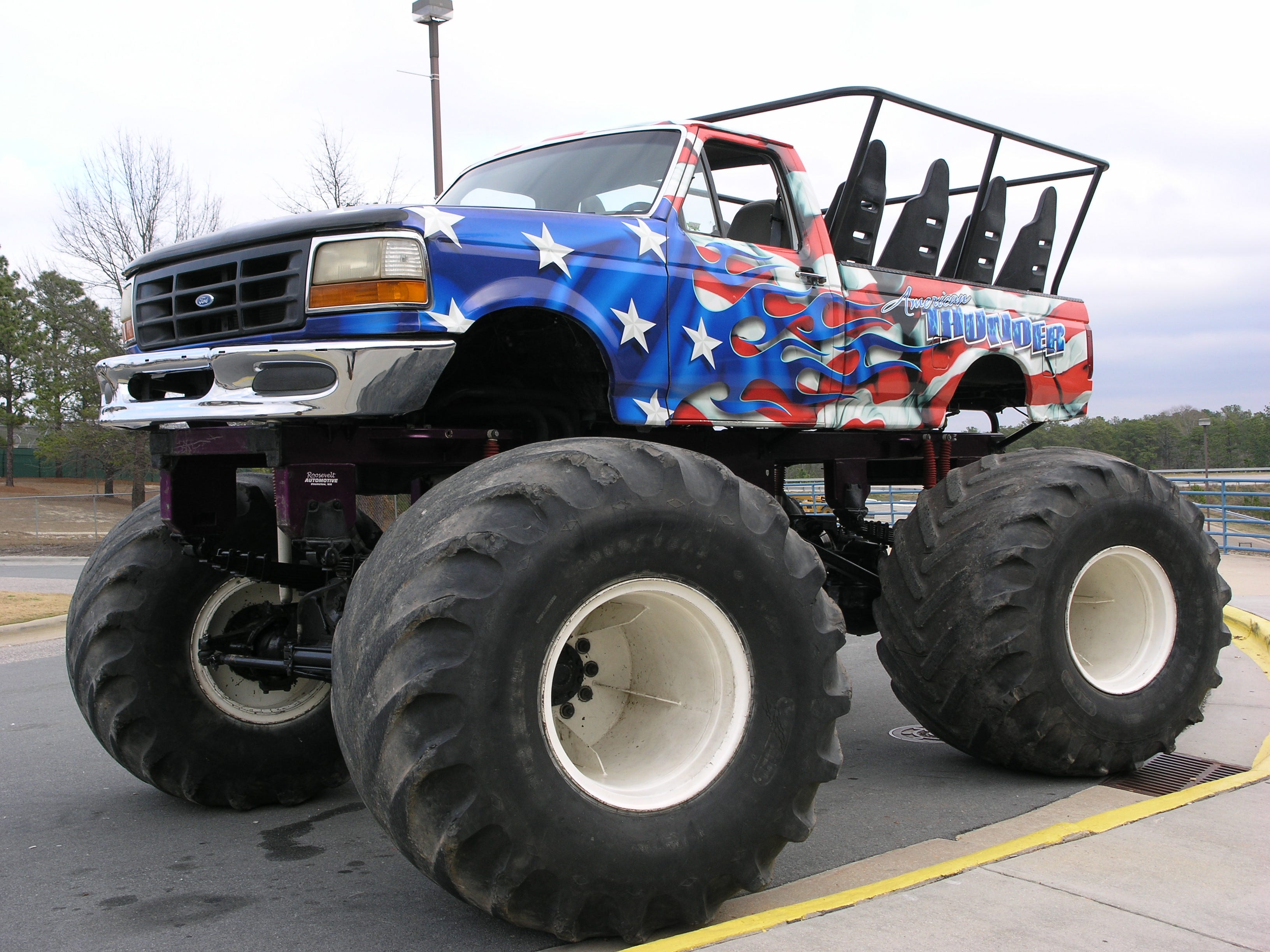
You’re reading Steam Calliope Scherzos, a blog that fiddles about with non-structuralist semiotics and media ecology. And today, you can enjoy this fashionably belated Fourth of July post.
Five years ago, the right-wing blog Revolver dot news published an attack on the Black Rifle Coffee Company, describing its all-American conservative-catnip messaging and imagery as both hypocritical and empty. Their CEO had just done an interview with the NY Times disavowing various elements of the conservative right, claiming that they want nothing to do with racists, “Proud Boy-ish” people, and others that glamorized the actions of Kyle Rittenhouse, who was at the time pending a trial verdict for the three Antifa supports he shot during one of those “fiery but mostly peaceful” protests from 2020.1 The reason for the CEO’s interview is evidently that Rittenhouse had been a fan of Black Rifle, and at the same time his trial was taking place, the company must have been slowly figuring out that those who actually buy their coffee weren’t necessarily the same people to whom it was being marketed. In February of the following year, they became a publicly traded company.
Black Rifle at first spread its name around using a certain kind of conservative-presenting buffoonery in its advertisements, a style that will form the topic of this blog post. This ad makes for a pretty good example of what I’m talking about:
It’s got more hackneyed, minstrel-show Americanisms than you could shake a stick at: a muscular tatted-up guy fires a gun that blows the clothes off of two sexy women. Some more firing of guns ensues. A couple of guys sit in an all-terrain vehicle and set off smoke flares while a fat black guy fires a flamethrower, propelling it backward. Another guy takes a tomahawk to a bag of coffee beans instead of just opening it like a normal person. Two more guys play the national anthem on electric guitars. Everyone swears a lot. This is some real dad-core stuff for Republican-voting baby boomers. And it’s a pretty wild marketing gambit for a company that couldn’t possibly be using American-grown beans, since outside of Hawaii America doesn’t grow coffee.
Revolver’s criticism of the company’s apparently hypocritical politics was what you’d expect, but the more interesting part occurs over halfway through the article when they go after Black Rifle’s aesthetics:
In many ways, the imagery that Black Rifle indulges is actively harmful. Male-to-female transsexuals famously have a cartoonish, porn-influenced, stereotypical idea of what being a woman is like. That’s why drag queens have such a garish, over-the-top look. BRCC ads evoke the same idea, but for men. Their target demographic is, in a sense, male-to-male transsexuals. The ads reduce veterans from citizen soldiers to a pantomime of desperate masculinity, guys who need tattoos, whiskey, and twenty-seven different guns to feel like “real men.” BRCC ads are supposed to trigger “snowflake” liberals, but they’d be just as crass and ridiculous to a World War 2 veteran in 1946.
It’s interesting to see a more dissident and “off the reservation” type of blog request more solemnity and seriousness from a company that was (from what I can tell) pretty well-connected to the conservative mainstream and continues to be even today. Its critique isn’t totally right, either: male-to-female transsexuals aren’t really the same thing as drag queens, and both groups seem to have a different idea of femininity from each other. But that last point is spot on. Most World War II veterans in the late 1940s would want nothing to do with such nonsense, and they would indeed find its overly macho self-presentation off-putting and forced.
Black Rifle Coffee, for their part, got the memo — or at least some version of it — and started toning down their promotional videos. Just a bit, anyhow. They probably intended on doing so as soon as they disavowed Rittenhouse’s vocal supporters. But they haven’t quite abandoned the overall feeling of Americana that their ads give to the consumer. This very recent video from a couple days ago is less trashy, but still garish and over-the-top:
Here, we’ve got supposedly the largest American flag ever towed from a vehicle on record (that’s their claim, anyhow), a helicopter, more ATVs, monster trucks, a bluecoat on horseback carrying a flag, a guy playing “The Star Spangled Banner” on electric guitar in a truck with a stack of amps straight out of Mad Max: Fury Road, we’ve got vintage American muscle cars, some more seemingly random gun fire, a ton of smoke flares shooting off red, white, and blue colors, and even some hot chicks — tastefully dressed, this time (after all, BRCC is now a publicly traded company whose stocks aren’t doing too great!), but present all the same.
Black Rifle makes heavy use of what I’ll call — just for the sake of giving it some kind of name — “American vulgarity kitsch.” It isn’t just American kitsch, because we already know what that includes. Normal American kitsch is stuff like Velvet Elvis paintings, various paintings of dogs playing poker, plastic lawn flamingos, and those gigantic 25-foot-tall fiberglass Muffler Man statues that you’ll sometimes find driving across the country. It’s just kitsch, simply put. There’s also a distinctly patriotic form of American kitsch that you’ll find in the paintings of Norman Rockwell and the great Art Nouveau stylist, J.C. Leyendecker. But what we’re talking about here is different. American vulgarity kitsch revels in America’s vulgarity, its crassness, its excess, its gigantism, and its grotesquery, and it suggests that the essence of true American patriotism is to be found in all of these things. It is also, as the Revolver blog understood, aggressively macho to the point of absurdity. Absurdity is the point.
This type of kitsch isn’t as easy to find in twentieth-century mass media as it is in the 21st. Elements of it were always there, but never as acutely combined into such a patriotic pastiche as now. It is a distinctly video-centered style, and I think one of the greatest contributions to it was the “American Bad Ass” music video from the rap-metal artist Kid Rock, released in the year 2000:
Here, you’ve pretty much got the template figured out. You’ve got explosions, motorcycle gangs, mud wrestling, adult film stars in cowboy hats and American flag bikinis, a midget, a muscle car, and more. Some of the stuff in this video is no longer viable for mass media consumption: you can’t have confederate flags any longer, the mud wrestling might be going a bit too far, and the appearance of disgraced male porn actor Ron Jeremy would now be regarded as unfortunate. And Kid Rock’s fashion choice of wifebeaters combined with 1970s pimp attire heavily influenced by Rudy Ray Moore probably wouldn’t be welcomed on anyone else. But the basic ingredients are all here. What really makes it work, though, is the brief appearance of a lawn gnome at 1:30 into the video, an iconic figure from the world of kitsch. That inclusion couldn’t be more deliberate, as it tells the viewer that yes, Kid Rock knows what he is doing. Everything here is fully self-aware.
The truth is that whatever one might think of it, America cannot and will not abandon this mode of self-representational kitsch. It is simply too pervasive within the depths of mass media culture to get rid of. Conservatives and Republicans have had de facto ownership over it for a long time, and they probably will continue to for a good while, but even the Democrats have started to recognize its power. Such growing recognition is probably what the Revolver blog was trying to warn its readers about. We saw the Dixie Chicks “infiltrate” country music back in the early ‘00s, and then Beyoncé Knowles recently did the same thing with her flamboyant “Cowboy Carter” country album in 2024. Prominent Democrat voters can inch their way towards the American vulgar sublime if they feel like it, and no one will mind. But for the time being, you can associate this sort of imagery with the Republicans.
What makes this association especially clear is in the way President Donald Trump took ownership over the style with supreme aesthetic mastery, as this image from his recent (BRCC-sponsored) Freedom 250 event demonstrates:
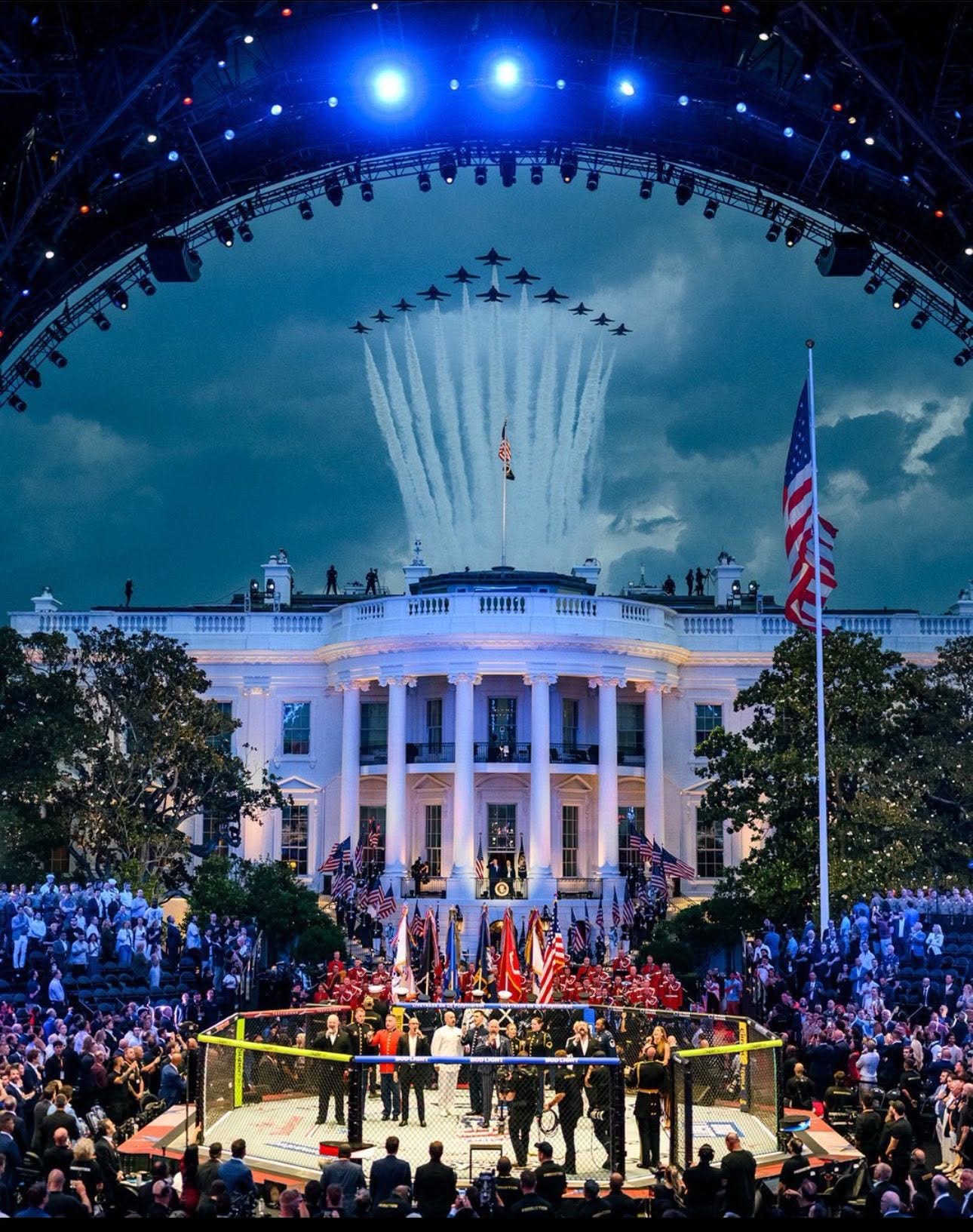
Just look at that bad boy. Its lighting has all the elegance of a Thomas Kinkade painting, and the streams from the fighter jets are beyond perfect. The scene looks like something you’d expect to find in a snow globe or some other kind of hand-painted miniature diorama, only it’s a little too macho for that — as per the intent. The choice of motocross, followed by mixed martial arts for the event is in fact what makes the whole thing really work. Its gaudiness sets the whole scene apart from conventionally upright, stately patriotism, and its violent and death-defying manliness is what sets the whole scene apart from conventional kitsch.
It also signals a different attitude toward violent spectacle from the political right specifically. Back in the early ‘80s, the perennially pencil-necked conservative columnist George Will had this to say about the fine sport of boxing:
It will be said that if two consenting adults want to batter each other for the amusement of paying adults, the essential niceties have been satisfied, “consent” being almost the only nicety of a liberal society. But from Plato on, political philosophers have taken entertainments seriously, and have believed the law should, too. They have because a society is judged by the kind of citizens it produces, and some entertainments are coarsening. Good government and the good life depend on good values and passions, and some entertainments are inimical to these.2
Well, in the year 2026, his viewpoint could not be any less relevant. The coarsening of America has been probably the greatest success of its own corporate entertainment industry, and its corporate entertainment industry has helped fashion an understanding of America that is singlehandedly defining its current patriotism.
In addition to its sheer power of spectacle, part of what makes the style work so well is that it doesn’t aggressively shun any of the critiques that have been made against America. Instead, it picks the ones that make America seem cool and incorporates them. When you look at these American vulgarity kitsch videos, you’ll hear many renditions of “The Star Spangled Banner” performed on electric guitar, a distant reference to Jimi Hendrix’s legendary performance of it at Woodstock 1969. Hendrix, of course, was a military veteran… but he was also discharged after it became apparent to his superior officers that he had no interest whatsoever in being part of the army. And his version of the national anthem, far from being a straightforward celebration of America, was instead performed as a protest against the Vietnam War, as the sounds of bombs and gunfire simulated atonally through the gain and distortion on his amplifier make clear. But does any of this matter? Well, no, not really. Bruce Springsteen’s “Born in the USA” can also be found in this presentation of American kitsch, and the same goes for CCR’s “Fortunate Son.” They’re also protest songs, and that doesn’t matter, either. What matters is that they rock, and they’re about America, and therefore they can show up on American car commercials and whatever else. In the same way that left-wing cultural commentators such as Slavoj Žižek and Mark Fisher have observed that capitalism will both absorb and commodify the various critiques against it, the same largely goes for American patriotism. The kitschified version of it does so splendidly.
This shouldn’t even come as too much of a surprise. I’ve spoken to people who lived in Communist Europe during the 1980s who practically worshipped Bruce Springsteen, and when they’d hear “Born in the USA,” or even something a little weirder, like David Bowie & Pat Metheny’s “This Is Not America,” they’d think to themselves, Yeah, America! Boy, America is great! and if anyone were to say to them, “You know, these songs aren’t pro-America, right?” They’d only respond, “Then all the better! We’re not allowed to make any songs like that about socialism!” And that would be that. The point is that America’s inherent allowance for self-critique is what enables kitschified patriotism to keep things on the surface without any problems. If the protest song rocks and it’s about America, then it’s a friend to America. As Meister Eckhart once put it, “Anyone by blaspheming God Himself, praises God.” So it goes for Uncle Sam.
The other big thing that makes this type of kitsch work so well is its relationship to the concept of irony. In The Unbearable Lightness of Being, Milan Kundera tells us, “In the realm of kitsch, everything must be taken quite seriously.” Kundera wrote this in 1984, and I’ll be the first to admit I’ve never bothered to read it, but even back then his claim was already dated. The seriousness of kitsch, its childish melodrama, had been a frequent target of critics for quite a while. Back in 1939, in his essay “Avant-Garde and Kitsch,” the art critic Clement Greenberg attacked kitsch for the immediate and unreflective emotional relationship it has to its audience, but he never envisioned a world in which kitsch could be appreciated ironically. But then the Pop Art movement came along and got big during the 1960s, and all of a sudden, kitsch was OK, so long as you can pretend that you’re “in on the joke.” What made all of this so exciting was that the best pop artists themselves left the matter open for ambiguity. Is Andy Warhol a genius…? a true connoisseur of the arts might ask himself. Or is he as dumb as a box of rocks….? No one knew. But the idea is that you could appreciate things made in poor taste while operating on multiple levels of awareness, and this response was soon championed by respected intellectuals such as Susan Sontag and Umberto Eco. With time, people started to recognize that kitsch didn’t need to be so serious.
Nobody picked up on that message better than corporate entertainment culture, particularly the advertising industry. In my earlier blog post “In Defense of Conservative Philistinism,” I observed that most of the philosophical questions about consumption and commodification posed ironically by the Dadaists and Pop Artists have been explored more successfully — especially nowadays — through the capitalist marketplace, and this same point holds for expressions of patriotism. Take, for instance, this ten-year-old Carl’s Jr. ad for something that they were calling “The Most American Thickburger”:
What’s more American than a cheeseburger? This cheeseburger… loaded with a hot dog and potato chips… in the hands of all-American model Samantha Hoopes… in a hot tub… in a pick-up truck… driven by an American bull rider… on an aircraft carrier… under the gaze of Lady Liberty… as she admires… the Most American Thickburger.
So, what the fuck is this, exactly? Is it a joke? Is it mocking patriotism? Or is it a genuine celebration of America? Even the cheeseburger itself seems like a joke — what kind of psycho would put a split hot dog and kettle chips on a perfectly good burger? And yet, you can buy this culinary abortion and even eat it, so we can’t accuse them of not having skin in the game, here…
The point is that the irony and sincerity are a package deal. You can experience both things at once, and there’s no contradiction in any of this. Yes, it’s hokey and ridiculous, and yes, it’s grotesque and postmodern, and yes, it undermines the dignity of America. But then again… all this stuff is pretty awesome. Pick-up trucks are cool, bull riding is cool, the Statue of Liberty is cool, chicks with big boobs in American Flag bikinis are cool… and, while we’re at it, hot dogs are cool, cheeseburgers are cool, and kettle chips are cool, too. So why not just throw ‘em all together into one big thing?3
People have referred to the multi-layered feeling that American vulgarity kitsch elicits as an example of “post-irony.” If you can laugh at something’s silliness while also agreeing with it, then you’ve gone beyond mere irony into some kind of new realm of “hyperreality,” or whatever. But I don’t think this is a useful characterization, since irony has always held this quality from the very beginning. Language is itself an expression of detachment, since there’s no motivated connection between a sign and its referent. All linguistic signs are thus, we might say, not really “sincere” in the absolute strictest sense, even though we can fully take them that way depending on the situation. The anthropologist and linguist Dan Everett wrote a book called Don’t Sleep, There Are Snakes (2008), named after the way the primitive Pirahã tribesmen whom he studied would say goodnight to one another. Everett sees no irony in their goodnight message, but it is clearly ironic. They realize that the person is about to sleep and thus their advice won’t be heeded, but they are nonetheless making a serious point about the importance of sleeping lightly, since there are actual venomous snakes slithering around. Here in America, it took Pop Art, then corporate consumer culture, then vulgarian kitsch to exploit the same complexity that has always undergirded irony. First it was done as a deliberate statement, and then, over time, an involuntary reflex.4
Liberal Democrats, it seems, never really got the memo about the multiple levels of appreciation that kitsch can elicit. At least, not when it comes to their own propaganda. Take, for instance, this absurd image from the Coronavirus era:
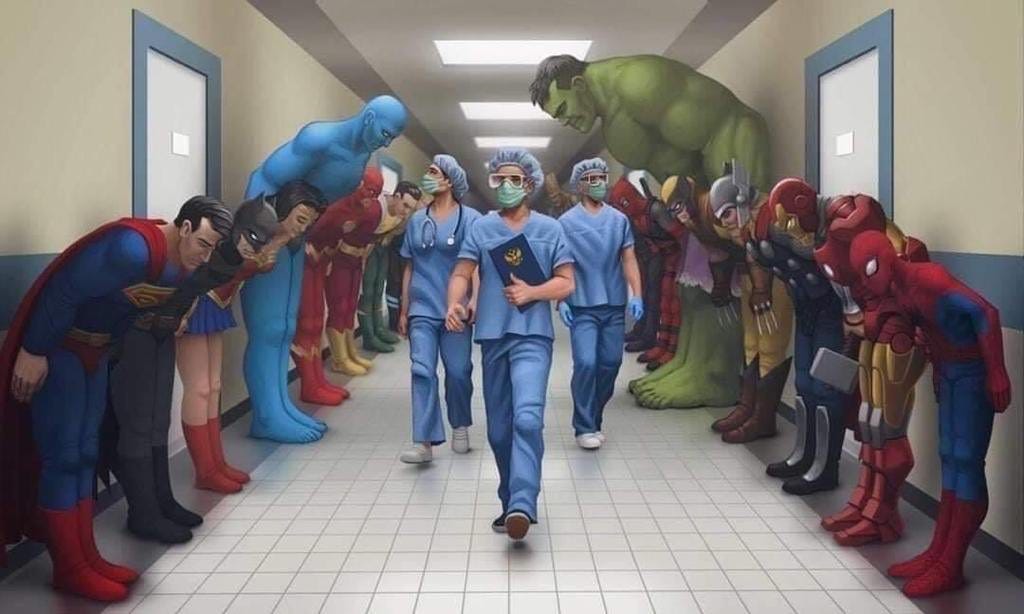
Just look at this monstrosity. Back in April of 2020 when this thing was first posted, you were actually expected to react by going, “Wow, oh my God. It’s so true. Doctors are the real heroes. Just wow.” Anything less sanctimonious would be taken for blasphemy.
But in the world of politics, the vulgar kitschification of patriotism has worked like a charm for the Republicans. Well, anyhow, it’s been working well enough for them to stick with it. Take, for instance, this 2016 ad by Rand Paul about “killing the tax code.” This is something about as likely to take place as hens growing teeth, but it does give Paul an excuse to show off his chainsaw and woodchipper while wearing some blue jeans and a baffling T-shirt that reads “Detroit Republican”:
And look — Rand Paul remains a senator to this day! You can also observe this more recent ad by the would-be congressman Teddy Daniels:
Alright, well, Daniels didn’t win and become a congressman. But he still nailed the style.
The thing about these sorts of ads is that they’re incredibly hard to make fun of. You can bring up the movie Idiocracy (2006) and the scene with President Camacho firing an automatic rifle up at the ceiling, and the people who enjoy the ads will just laugh and go, “Hell yeah, that movie’s hilarious. President Camacho kicks ass!” And, well, that is that. What more is there to say? As I’ve suggested, there’s an air of self-awareness to the vulgar kitschmongers that precludes all mockery. It even succeeds in making left-wing attempts to satirize them look comparatively stiff and humorless.
Now, for all its merits, the question still remains: what is the future of this style? It is certainly possible that American vulgar kitsch will disentangle itself from direct politics in the future. The problem is that American Republicans have been running around presenting themselves as antinomian libertines, even while there are still religious elements within their party that aim to pass various acts and reforms which stifle rather than grant freedom to the citizens. The Republican-approved KIDS Act — a massive legislation package that diminishes internet freedom while expanding the government’s ability to surveil its citizens — is as good an example as any. There’s a point in which such hypocrisy might be too much for people to take, although I’ve been surprised at how far it can go.
But whatever its future in politics, American vulgar kitsch itself doesn’t seem to be going anywhere more generally. American identity has become too divested of ideological, religious, or even historical substance to express patriotism through anything weightier. Most of America’s major historical figures elicit sharply divided responses, and even when people feel uniformly positive about an American figure, their reasons might differ vastly. If you’re a Democrat, you can appreciate Alexander Hamilton, for instance, since he did have a highly successful hip-hop musical made about him. But it better not be because of his views on immigrants, or his creation of the electoral college. The same principle extends to most of the founding fathers, and it’s true for informed voters in both parties. So, if you can’t really get specific about anything, and much of the American sense of history has been aggressively dismantled by the education system as well as the mainstream news media, then what can you do? Well, you can celebrate the fact that America has a world-dominating arms industry, a world-dominating sex industry, some great vintage cars, rock music, extreme sports and pugilism, and an all-around flair for the gigantic and the grotesque. We can all agree that these things are undeniably powerful. They generate intense feelings, whether you want to experience them or not.
As with most things aggressively American, I’m ambivalent about this style. American vulgarity kitsch is a poor substitute for a deeply felt sense of identity, one that comes with the feeling of belonging to a collective that knows its own origins and strives toward its shared destiny. But it also celebrates the things that America does better than just about anyone, and it’s refreshingly honest in the way it portrays itself. Plus, there’s always a dim chance that the style, notwithstanding its shallowness, could actually point toward something that extends beyond itself in its current state.
I’ve written about the concept of collective mnemotechnics on a couple different occasions. Collective mnemotechnics, to give it a concise definition, is the externalized, institutionalized set of practices through which self-conscious and distinct groups of people remember themselves, preserve a sense of their common history, and stay mindful of their shared evolution. For Americans, self-remembrance has always been a bit tricky, since the country is so young. And to make matters even trickier, right from the start, Americans made a point of distancing themselves from their deeper genetic connection to England, even going so far as to reform their spelling and grammar, something that the equally Anglo-Saxon nations of Australia and New Zealand never bothered to do. For that reason, unique figures of American mythology, being so new, have survived through commercialism and the culture industry, often without any other means of sustenance. For instance, Paul Bunyan is an American folk hero that did come from an oral tradition, but after about thirty years of unmediated tall tales, his legend was co-opted by a lumber company advertiser, he was given a distinct image, and this changed his presentation and collective understanding forever. Other American folk heroes have met with the same treatment. Davy Crockett, once a real guy, is now mostly known through the live-action Disney show about him. Samuel Adams is the guy on the beer packages. In the collective imagination, he’s about as real as Bigfoot, which is the name of a huge pizza you could get at one time.
So, when you’ve got a country that lacks shared values,5 a shared sense of heritage, a shared understanding of its own history, and a shared folklore, the corporate entertainment industry is the main thing you’ve got, and American vulgarity kitsch — even with all of its self-awareness and irony — is ultimately the most powerful statement you can make with it. And indeed, it does constitute a statement. Patriotism currently expresses itself through this style because it is the boldest one available, and no other contender has managed to come close. But more interesting than its boldness is the fact that it isn’t exactly neutral — no vehicle of expression is. It sure is saying something… but no one is exactly sure as to what its message might truly be. As Black Rifle Coffee puts it, “Because America, that’s why.” Oh, OK, thanks for clearing that one up. In this presentation, America is the tabula rasa, and it’s waiting for you to write the text. Perhaps one of the underappreciated virtues of kitsch is that when a people has been denuded of its more elevating and demanding characteristics, kitsch can at least preserve its iconography, keeping its constitutive images on life support as they wait to be quickened once again.
I’ve often thought about the possibility that over time, American vulgarity kitsch could wind up engendering its own substance, perhaps its own values and metaphysics. This notion might seem absurd now, yet less likely things have happened. However, given the disjunction between the messaging and the follow-through of America’s corporate culture, its advertising, and its politics, the latent substance of American vulgarity kitsch might only ever point to a mode of being that remains consigned to the world of images and reflections. And there, it just might remain.
edit 7/6/26: fixed a couple minor typos
Rittenhouse, who pleased self-defense, was acquitted of all charges — something that should have been predictable to everyone, given that the whole encounter was captured on video and corroborated his story.
George Will, Boston Globe (Nov. 23, 1982). Quoted in Combat Sports in the Ancient World by Michael B Poliakoff, 1987.
There’s no coincidence, by the way, that the same man who oversaw all of these Carl’s Jr. ads, Andrew Puzder, was nominated for the Secretary of Labor position under Donald Trump’s first administration.
This point actually isn’t limited to America, though Americans exploit it better than anyone. For another example, there’s a right-wing French nationalist metal band called Peste Noire whose song “Casse, Pêches, Fractures et Traditions” ironically invokes the kitschy image of the accordion-playing, baguette-eating Frenchman while also making a sincere statement in favor of French patriotism. Same duality, same ambivalent recognition of national identity being shaped by mass media and the tourism industry.
This is actually a tricky point. In reality, most Americans express largely the same moral values when polled, even on contentious topics like race or religion. But they do not believe that they have the same values, and they often don’t like to see these values reflected back to them through politicized conduits. They also do not agree on whether or not specific policies or laws reflect those values well. So, rather than being polarized, it is more accurate to say that Americans are partisan. America’s value unity is a credit to the sophisticated propaganda techniques of its mainstream journalists, while America’s partisanship is a credit to the skilled advertising techniques of its two parties, which owe a lot to consumer culture.
This reminds me of your old "pretentious rhetoric" essay's invocation of "vast, sprawling baileys" in which people are entirely ignorant of any more logically coherent or sophisticated "motte." Not a perfect parallel, but maybe you see what I mean.