
Art Forms of Proprioception
And equilibrioception, as well. Can't forget that one.

You’re reading Steam Calliope Scherzos, a blog that deals with all the tough questions that life has to offer… so long as they pertain to Peircean semiotics and McLuhan-style media ecology.
Here’s a question: how many senses do we have? If you’re like most normal people, you say five. They are (in no particular order) touch, taste, hearing, smell, and sight. That is, after all, the answer that Aristotle gives us in his De Anima, and it has been a pretty resilient classification scheme up to this point. One academic philosopher has recently argued that there are just five senses and five senses only, and it is all really quite obvious, so the persistence of Aristotle’s model is not so much because of Aristotle’s great reputation among the hoi polloi as it is the often underrated value of folk wisdom. But not everyone buys this five-sense model, or that particular argument. Some other academic philosophers, such as Fiona MacPherson, believe that there are at least some more that we ought to include, such as various interoceptive senses. Interoception refers to the senses that perceive interior bodily states, like our body temperature, hunger, wakefulness, and anxiety. Exteroception, by contrast involves senses that perceive what’s going on in the external world, and they include the five classical senses. Whether or not we believe that interoception should be included, it certainly is worth asking the question: when we “feel” ourselves becoming hungry or tired, are we doing so because we are “touching” something? And if not, then what the hell is that feeling if it isn’t coming from a sense of some kind?
In her introduction to The Senses: Classical and Contemporary Philosophial Perspectives (2011), MacPherson makes a case for two senses that really ought to be included in the classic canon of senses: proprioception and equilibrioception. And others seem to agree. Here’s a definition for “proprioception” from a web site called Sixth Sense Abcderium:
The term proprioception is composed of the Latin proprius (one’s own) and perception and thus literally designates one’s own perception. It is the sense of position and posture, movement and velocity of the body and body parts. This involves the location of our body or body parts in space, the relation of our body parts to one another, and the extent to, and pace at, which they change their position. Some accounts also attribute to proprioception a sense of effort through which weight can be evaluated and a sense of touch through which the size and shape of objects as well as the geometry of external space can be detected.
Now, this is an interoceptive sense, since it involves understanding the internal dynamics of the body. It isn’t quite the same as the way we sense our internal organs’ needs (hunger, sleep, etc.), but it’s adjacent to those senses, and it certainly isn’t exteroceptive. Proprioception involves the body’s various parts in space, yes, but it doesn’t seem to arise beyond the awareness of where each body part is in relation to the other, and so it can’t qualify. Proprioception, taken as a standalone sense, helps us to understand things like how we’re able to tie our shoes without looking at them. Yes, we are touching the laces, and that’s all very helpful, but we have to know where our fingers are in relation to one another as well. Similarly, proprioception can help us to identify the shapes of objects we can’t see. If we close our eyes, extend our fingers, and touch something in the shape of a tetrahedron, we can’t simply identify the shape based on touch alone. We have to know where are fingers are in relation to the other when we feel its contours. All of this involves an awareness of our body’s internal state of existence.
If we want to explore an exteroceptive sense that determines where the body is in space, then we would have to look into equilibrioception, which is our sense of balance and spatial orientation. One might object that it can’t be a standalone sense because it relies in large part on our sense of vision: if you try to hop on one foot with your eyes closed, you’ll find that it’s much more difficult than if you fix your line of vision on a point in the room. But equilibrioception also relies on proprioception (of course) as well as something we don’t think of too often, namely the vestibular system located in the inner ear. The inner ear’s connection to balance explains why some inner ear infections, such as labyrinthitis or vestibular neuritis, will cause you to become dizzy, nauseous, or suffer a feeling of vertigo. But if your proprioceptive senses and your vestibular system are in good working order, you will be able to sense where your body is in space and how to adjust it to retain balance, even without the aid of vision. And it’s exteroceptive because when it’s most active, it responds to real external changes that the body is going through.
Having established these two senses of proprioception and equilibrioception, let’s consider this fun question: can there be art forms that primarily stimulate these senses more than all the others? Keep in mind, I’m talking about the effect that the art forms have on the audience, not the artists themselves. Another academic philosopher, Jiri Benovsky, wrote a book called The Limits of Art: On Borderline Cases of Artworks and their Aesthetic Properties (2020), and he does indeed contain a section on proprioceptive arts. But he deals mainly with arts that concern the experience of the artists themselves, not the experience of the audience. In this conceptualization, dance, rock climbing, and martial arts are all considered proprioceptive arts, but the problem is, if you’re an audience to any of these things, then you yourself are not going to feel your proprioceptive or equilibrioceptive senses stimulated, unless perhaps you are very good at imagining yourself in the position of the performer — enough to undergo some psychogenic experiences of imbalance or bodily motion. The question of how art can affect the proprioceptive senses of the audience is therefore a bit trickier, though I think it’s the more interesting one. After all, if fine dining is an art form for the gustatory sense, and perfume is an art form for the olfactory sense, then why can’t there be an art form that primarily stimulates proprioception and/or equilibrioception?
Whether “proprioceptive art” can really exist seems to be a live albeit obscure academic question, as this introductory lecture to a conference on “Proprioceptive Art” from 2022 with only 153 views indicates. But it seems to be pretty obvious to me that a work of art can primarily stimulate the proprioceptive sense, and that moreover it can be quite popular despite having no literary qualities or narrative or philosophical elements, or anything at all that we might describe as “smart.” The proprioceptive/equilibrioceptive senses cannot pick up on language, much like taste or smell, although vision, hearing, and even touch (through Braille writing) can. Thus, if an art work communicates its artistry primarily through the proprioceptive/equilibrioceptive sense, you can be reassured that it probably won’t make a “statement” or tell you anything particularly profound about “the human condition” without some kind of buttressing. Proprioceptive arts don’t seem to work that way.
Now, having said all of that, there is no question that proprioceptive art does indeed exist. Interoceptive arts exist, too: we can interpret pornographic or horror movies as artworks of interoception… or even mawkish works of sentimentalism, ones that intentionally try to make the viewer cry for whatever reason. These are art forms for the brain, not the “mind.” That is, they specifically try to elicit a physical reaction pertaining to the body’s internal chemistry. Most of these art works are frowned upon and dismissed as “cheap”… unless, of course, the cheapness carries some sort of ethical justification.
But for this discussion, we’ll just look at art works that manipulate the feeling of being situated in space. I’ll explore some using three broad categories. Here’s the first.
Virtual reality headsets as well as extremely large visual displays
In this category, the sense of vision is used to create the illusion that the body is moving through a certain kind of space different from that in which it is currently situated. I first encountered this kind of proprioceptive feeling as a fifth grader when we went on a school field trip to some museum, and there, we watched an IMAX short film about mountain climbing. Maybe it was Everest, I don’t know. I also have no idea what the museum was or what the trip was supposed to teach us, but in this short film, a point-of-view shot is presented at one point, and it looks directly downward from one of the ledges so that the viewer can see just how far the climber has brought himself upward. Although I remember very little else about that day, I do vividly remember feeling weightless when the camera tilted downward, as if I were about to fall. It was not unlike the sensation people sometimes get when they have a dream about falling down, they abruptly wake up, and then they still feel like they are in the process of falling for about a split-second, sometimes physically jerking their heads forward.
Because vision is so closely connected to the feeling of equilibrioception, large two-dimensional displays that take up either most or all of the viewer’s eyesight range can by themselves foster the feeling of being weightless, or suspended, or upside-down, or otherwise spatially compromised. Theaters with incredibly large screens (such as IMAX) can generate this feeling, but so can VR (virtual reality) headsets, which are available for purchase as home entertainment. I haven’t yet played around with a VR headset, and I also think they look too silly for me to want to try one, so I can’t really say much about the device from personal experience. But looking through a brief catalogue of upcoming VR games gives me a pretty good sense of what VR can do. Among the games, there are lots of rhythm/action hybrids where you physically engage in some kind of action set to a rhythm (similar to the highly popular Dance Dance Revolution, which is certainly proprioceptive), there are exploration/sandbox games, first-person combat games, flight/vehicle simulators, and exercise games in which the player is compelled to physically exercise.
One point worth considering, however, is that VR is not growing in popularity as much as investors have hoped. It was first introduced back in the 1990s and tech enthusiasts seemed certain that it would instantly take over the entertainment market… and yet it did not. Three decades later, its growth has still failed to meet expectations. For instance, Meta (formerly Facebook) spent about $73 billion on what it hoped would be a large interconnected virtual reality social space, and this failed pretty badly. Even point-of-view pornography for the VR helmet is not selling too well, and porn is often a good predictor for how well a medium will succeed. It is possible that for all of virtual reality’s immersive potential, people nevertheless simply don’t want to buy something that makes them look dumb.
Immersive Museum Installation Art
Now we can turn to something that is actually quite successful — at least according to some much lower standards — and that is gallery art installations that directly engage the proprioceptive/equilibrioceptive senses. These installations achieve such an effect in a couple different ways: first, by optical illusions (as with extremely large or VR displays), and second, directly, often by creating rooms designed to manipulate the body’s position in space. There are a few examples I’ve been able to find, so let’s get into them.
Yayoi Kusama’s Infinity Mirror Rooms
In these installations, viewers walk around rooms in which cleverly placed mirrors reflect upon each other endlessly. Large amounts of hanging lights with bright colors adorn the space, and they look pretty cool. And because the mirrors have the effect of dissolving a stable visual horizon and making the contours of the rooms hard to locate, what results is a floating, disorienting spatial experience for the visitor. Here’s a YouTube video discussing them:
The “Performance Architecture” of Alex Schweder, particularly “ReActor”
Schweder, sometimes with the help of partner Ward Shelley, creates architectural installations with the purpose of being immersive and participatory. Some of them seem to involve only performance artists who engage with the work as part of the display, and some of them seem to be open to the general public. One piece in particular, ReActor, is a long studio-apartment room that balances upon a fulcrum, so if everyone walks to one side, then it will tilt in that direction. Maintaining equilibrium forces the people in the room to be distribute their weight evenly on both sides. It also twirls around with the direction of the wind. See it here. It doesn’t look like it was open to the public back during 2016-2018 when it was being displayed, so it sadly doesn’t count. But if had been, then it would definitely engage its audience equilibrioceptively. Maybe one day the idea can be expanded upon.
“Planets” and “Borderless” by teamLab
If you want to go to a real tourist trap in Tokyo, Japan, you could hardly do better than the MORI Building Digital Art Museum, which features two permanent installations, “Borderless” and “Planets” by teamLab, a group of digital art engineers. The main purpose of these installations is to be highly immersive/interactive, with “Planets” even going so far as to make you take off your shoes and walk around in streams of water within one of its sections. “Planets” also features an “augmented reality” wildlife-simulation area for cell phone interaction, where you “catch” little digitally projected animals on the walls with your cell phone and then have the option of “releasing” them back into the wild. It additionally has areas where visitors are encouraged to jump up and down, climb onto platforms, and slide down slides, and various colorful lights and images will respond to their actions. Here’s a video of it below, and it looks like a whole lot of fun for little children:
These installations are wildly popular, they each take about two-three hours to get through, and they regularly have long, long lines of visitors at the entrance, as this video comparing the two installations explains.
Installations at the Turbine Hall in the Tate Modern art gallery, particularly “Test Site” by Carsten Höller
The Turbine Hall at the Tate is a good place for exhibiting proprioceptive art installations, and it is no enemy of interactivity, as you can detect from the web site for the location, which prominently displays a photo of little children playing around on the guard rail accompanying a ramp. If you take a look through their catalogue, you can find plenty of examples of works that involve direct participation, but perhaps the most conspicuous is “Test Site” by Carsten Höller, pictured here. It’s just five metal slides. You go up high, and you slide down, and that’s about it. It’s pretty cool, right? Who doesn’t love a big ol’ slide? Even The Beatles had a song about how great slides are, which Charles Manson famously took to be a prophecy of an apocalyptic race war. But it wasn’t any such thing; it was just a statement about how much slides kick ass, and you know what? They sure do.

Now, all of these installations have been quite popular. They have succeeded in garnering quite a lot of attention from the public. Some of them are big-time moneymakers. But there’s a problem: the professional art critics don’t like this stuff. They see most of it as spectacle for the sake of spectacle, with no deeper meaning behind any of it — just a way to generate interest from the masses, who themselves are only interested in cheap thrills and nice backdrops for their selfies on Instagram.
And to be honest, these critics are not entirely wrong. There’s nothing “high art” about these installations, and it’s not like they’re not in the tradition of ready-mades, which were originally supposed to be conceptual and anti-aesthetic. These installations don’t even qualify as pop art, either. Whereas critics could convince themselves that Andy Warhol was actually a deep and sensitive soul who was making some kind of statement about the repetition and vapidity of celebrity/consumer culture, no one can really say in a parallel fashion that, for instance, Carsten Höller is making a statement about the, uh… place of, err… slides… in our society. So while the installations might succeed on a level of pure enjoyment, they seem to fail at the level that they’re ostensibly aiming for. Or at least the level for which the concept of the museum/gallery suggests that they should aim. So let’s turn our attention to the kind of proprioceptive art that actually succeeds in what it’s trying to do.
Amusement Park Rides
Alright, now this is the good stuff. This category makes up easily the most successful example of proprioceptive art forms, and probably by a long shot. I’m not the only one to notice this as well, as can be seen from this talk from the above-linked proprioceptive art conference, although the speaker, Charles Spence, really struggles with accepting such fairground rides as “art.” And the reason isn’t hard to grasp. Amusement parks aren’t thought of as places where you go to experience art, and if they were, people would probably like them less. The rides aren’t created and designed by auteurs but rather teams of engineers working for design/manufacturing companies, which means that few of these incredible monoliths of architectural ingenuity can be attributed to any one artist. And the sheer commercialism required to keep amusement parks financially solvent means that the images and sounds accompanying the rides will always have to appeal to the lowest common denominator. Therefore, you can expect plenty of “adolescent” or “juvenile” themes, or corporate entertainment franchise tie-ins when you visit a theme park. Whereas museums and galleries are uncomfortable with the concept of “the spectacle,” there is no such discomfort in amusement parks, where “the spectacle” is in fact their bread and butter, contributing indispensably to what then becomes a full-body experience. Essentially, amusement parks are unapologetic about what they are: places where you go to have your body jostled around by gigantic machines, screaming and laughing all the while. So let’s just consider some of the different kinds of rides.
Slides
We’ve already encountered slides in museums. Welp, amusement parks had them beforehand, and they often look cooler, too. Slides are special because they involve primitive technology, and they’re in fact the most primitive ride an amusement park can contain. They take a number of forms, but “helter skelters” (remember that Beatles song) are among the oldest and most well-known, often seen not just in amusement parks but also on boardwalks and water fronts because they’re specifically designed to look like lighthouses (see here).

Water slides
If you want to get complicated with slide design, water slides are where you should turn. By adding water to the slides through an elaborate pump system, some friction is eliminated, and therefore, longer and/or steeper declines become possible. They can look pretty cool, too, like this perplexity of slides from WhiteWater World, located in Gold Coast, Australia. If we want to think about art that really makes a “statement,” perhaps the greatest artistic masterpiece within the genre is the “Cannonball Loop” from the now-defunct Action Park in New Jersey. It actually contained a loop-de-loop — something highly unusual if entirely unique, especially since there was no flume or raft involved — and Wikipedia explains its history like so:

The slide was open for only a month in 1985 before it was closed at the order of the state's Advisory Board on Carnival Amusement Ride Safety, a highly unusual move at the time. One worker told a local newspaper that "there were too many bloody noses and back injuries" from riders. Some early riders came back with lacerations to their bodies, whose cause was later determined to be teeth that had been knocked out of riders' mouths and become lodged in the interior walls. A former Navy physician found that riders were experiencing as much as nine Gs of acceleration as they went through the loop.
For context, nine G-forces will cause the average person to lose consciousness after just a few seconds, while longer exposure will result in serious bodily injury. Additionally, a very short spike of 30-50 Gs will typically cause a serious, life-altering injury, while 70-100 will result in death instantly. For this reason, just about every amusement park makes its users experience only about 3-5 Gs maximum.
Essentially, during the Cannonball Loop water slide, mere enjoyment takes a backseat, and interaction with the artwork becomes something more akin to a life-altering experience of the sublime. It is fairly easy to see why this ride only lasted a month.
Carousels AKA merry-go-rounds
This is about as classic of a ride as you can get. You sit on a horse-shaped seat and go around in a circle. Bonus points for the ones that feature classic organ music, adding to the gentle but distinct multi-sensory experience.
Swing rides
These are “souped up” versions of the classic merry-go-round carousel, in which swings are suspended from the top of a revolving carousel. If the ride is especially good, the carousel will then tilt around in various directions for some added variation in the movement.
Haunted swing
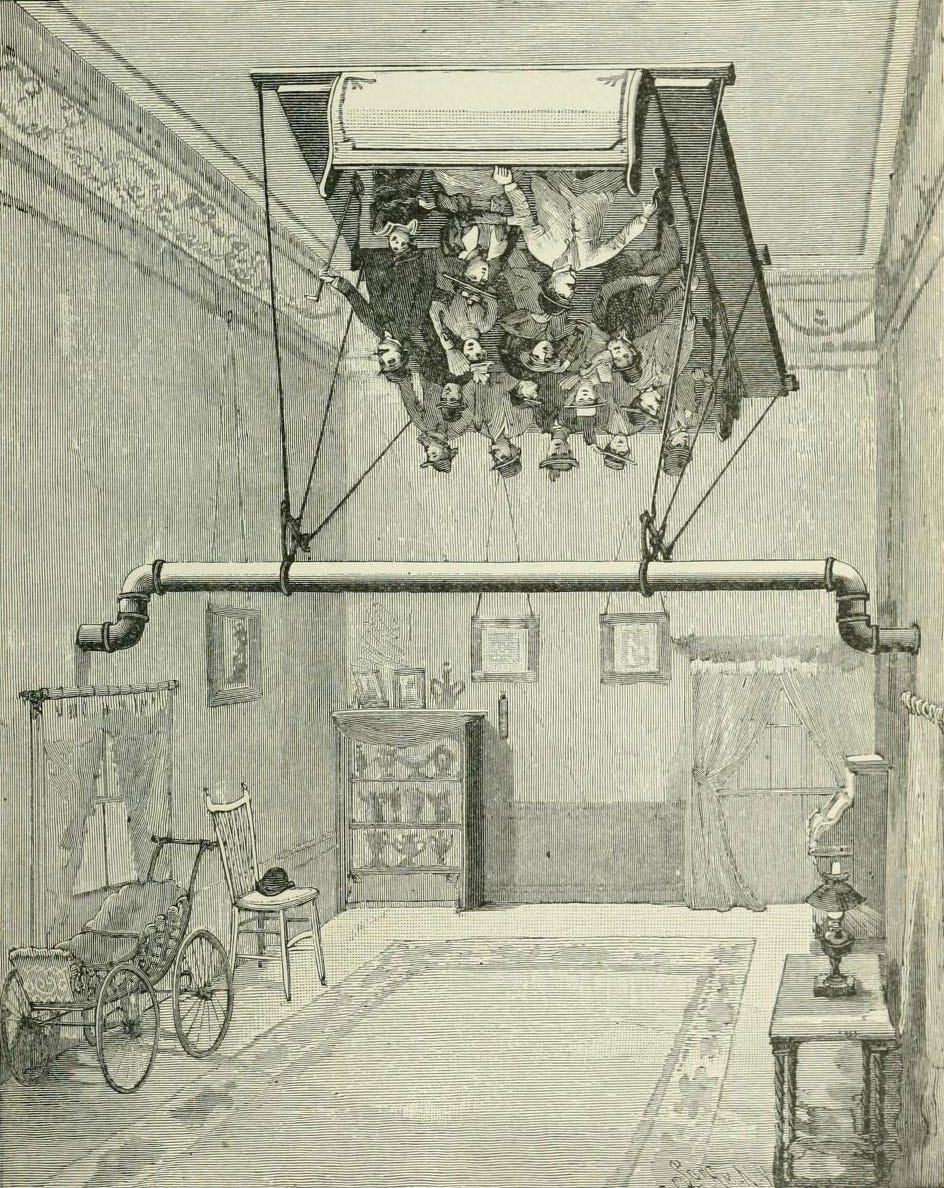
This is a curious style of ride, and there aren’t too many of them since they would tend to induce feelings of nausea. First designed in 1893 (it’s depicted at the top of this blog post), the haunted swing intelligently deploys visual illusion in addition to actual bodily manipulation. The idea is, park-goers sit on a platform within a room, which swings back and forth. But as it swings, the room itself rotates with the swing, and the room gradually starts to rotate more than the swing. The room eventually goes to a full 360 degrees over and over while the platform continues to swing normally, creating feelings of maximal disorientation, making the rider feel as though she is being flipped over, or perhaps descending into madness. The most elaborate example is the Villa Volta, located at Efteling in the Netherlands, with a platform that seats 78 people. The ride takes ten minutes to complete and it has apparently gotten mercifully slow over the years, which probably makes nausea less of a problem, but which might cause boredom for the riders (here’s a video).
Drop towers
You sit in a gondola, you go up to the top of a gigantic tower, and then you free-fall, only gradually slowing down at the bottom with a (usually) magnetic braking system. Some drop towers will blast the riders up into the air, while others will slowly raise them, giving them quite a while to contemplate the experience that they’re soon going to go through.
Pendulum rides
A gondola is attached to an arm, which is attached to a suspended axle. The gondola simply swings back and forth using the axle as the fulcrum. Some versions feature a counterweight on the opposite end of the axle, which will allow the gondola to go through a full 360 degree inversion. Pendulum rides are often modeled after pirate ships (like this one here), since such a platform can seat a fairly large amount of people while looking cool, though the themes can vary. One structural variation is known as the “Frisbee,” in which the gondola rotates as it swings. Very few Frisbees, if any, will swing a full 360 degree inversion due to nausea-inducement. Here’s a video of “CraZanity” at Six Flags Magic Mountain, a Frisbee and in fact the world’s tallest pendulum ride.
Roller coasters
Alright, now, there are plenty of other kinds of rides that we can discuss, and I’d gladly talk about all of them if I had the time. But to avoid needless repetition, lets just jump over to roller coasters, the grand daddy of all proprioceptive/equilibrioceptive art forms. Roller coasters have an extraordinary amount of types to choose from (wooden, suspended, inverted, bobsled, launched loop, mine train, floorless, boomerang, 4th dimension, wild mouse, twister, side friction, single rail, etc.), and their design always aims to achieve a delicate balance in which the riders feel thrilled and excited, yet do not feel nauseous, nor become imperiled by exceeding a certain amount of either vertical or lateral G-forces, which as I mentioned can cause bodily discomfort or injury. The most Gs a roller coaster has ever reached was around 6.5, the “Moonsault Scramble” at Fuji-Q Highland, Japan (video here), and it was one of only two coasters ever to put its riders through a pretzel-style knot formation. Sadly, it closed in the year 2000.
The roller coaster is a fascinating architectural innovation because it evolved alongside railway technology, and it has always been with us through the development of modernity. The first major one to show up in America was the “Switchback Railway” from Coney Island, which debuted in 1884, and as transportation technology has grown more complex, so, too, has the roller coaster. I find this fascinating because it suggests that as soon as the infrastructure started to develop within industrial modernity, there was always a parallel development in which the same tools and devices that made up modern urban and commercial infrastuctures were always being rearranged in a grotesque manner and presented as an attraction, as if to reflect modernity’s most fascinating and/or disturbing possibilities back upon it. It thus makes perfect sense that the fairgrounds also commonly feature halls of warped mirrors, themselves also proprioceptive works of art.
But unlike most of what we encounter in modernity, roller coasters are actually among the most honest works of architecture/transport that there are. There is no façade to a roller coaster. Most works of architecture try to cover up their mechanical processes with a nice, sleek, eye-catching exterior to make the patrons try and forget the skeletal structure within. With the roller coaster, the skeleton is the entirety of the visual design, and park guests can almost always see their supports, chains, brakes, guts, nuts, bolts, levers, and wires with ease. Although the roller coaster certainly gives the patron a visual experience, the visual appeal isn’t found so much in the ride design itself (except incidentally) as it is in the sights that the rider catches when going through the actual ride.
Now, this is quite interesting, because when you see the roller coaster from a distance, you know exactly what is going to happen: the experience is mapped out for you upon your first glimpse. And yet you go ahead and ride one anyway because you know that the bodily experience is going to be starkly different from the mere visual knowledge of what’s in store when looking at a distance. In other words, you go because the “map” is going to be different from “the territory,” the latter being bodily sensation. Compare that sort of transparency to the murkiness of, say, a haunted house, which is appealing precisely because of what’s hidden, only waiting to reveal itself through blind corners, hidden passageways, and trap doors.
It is quite clear, to me anyway, that roller-coasters mark the apex of proprioceptive/equilibrioceptive art, but because of the characteristics I’ve mentioned of amusement park rides in general, it is unquestionably a lowbrow art, and it must remain that way. As I said above, equilibrioception is a non-intellective sense, which means that one cannot use it to communicate language. Therefore, there is nothing innately symbolic about it, and the only way to make it symbolic is by affixing a thematic subtext to it. A ride can be “about” snakes, or birds of prey, or panthers, or mythical creatures, or the Batman, or the Joker, or something similarly exciting, but that’s about it. The subject of the ride has to match the intensity of the experience. And once the ride is finished, the rider never really thinks about how it has communicated to us something deeply penetrating and insightful about the nature of any of these things. I learn nothing about anacondas by riding a roller-coaster named after one.
Now, to be fair, I suppose that one could try to make a roller-coaster about something deeper and more cerebral. He could make one in tribute to, I don’t know, the victims of Hiroshima, or some other intense historical trauma that has been the subject of many novels, pieces of classical music and artistic films — and he could even make the ride deliberately unpleasant, to mark the sincerity of his intentions. But most would still regard the gesture as tawdry and cheap, not artistically valid. And they would probably be right.
Nevertheless, one cannot do a whole lot better for aestheticizing the sense of proprioception than an amusement park. And any professional artists or MFA degree-holders who want to “elevate the medium” of the amusement park ride will probably only be able to do so by making the art worse.
edit 2/5/26: added a link I forgot to insert