
"Endless Waltz" (1995)
A free jazz movie for people who hate free jazz

You’re reading Steam Calliope Scherzos, a blog that fiddles around with media ecology and non-structuralist semiotics. I occasionally discuss jazz and jazz-related media.
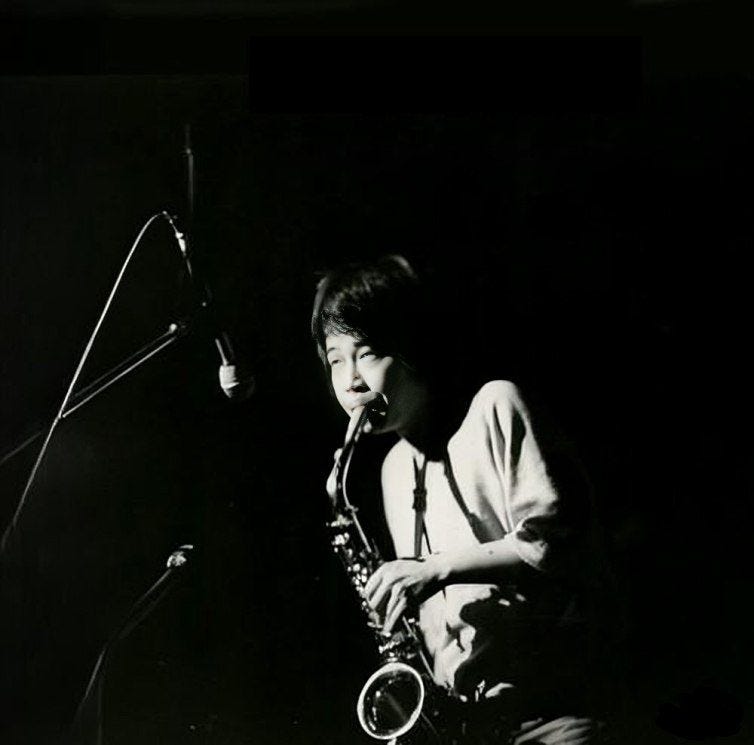
In the past, I’ve remarked that Japan carries a privileged perspective when it comes to exploring jazz strictly as an art form, since the Japanese don’t have to spend any time focusing on the genre’s deep sociopolitical underpinnings. Which is to say, being neither white nor black, the Japanese don’t have to assume the standpoint of either the aggressor or the aggrieved — a condition that affects even the Europeans despite their distance from American history. Still, however, there are political elements to Japanese jazz (just as there are to all art forms), and Japan’s relationship with free jazz is particularly rich with them. Kōji Wakamatsu’s Endless Waltz (1995) is one example of a jazz film with a strong political subtext, though it has nothing to do with the trans-Atlantic slave trade or American racism. Instead, it deals with the phenomenon of Japanese free jazz, which blossomed in the aftermath of the 1968 student protests worldwide and whose attitude was largely formed by the student left. At least for a while.1 The film’s main purpose is to tell the story of the romance between feminist sci-fi author, actress, and nude model Izumi Suzuki and the legendary free jazz alto saxophonist Kaoru Abe, whose mythic status grew ever-more steadily following his death from a drug overdose at age 29. But the subject matter allows the film to explore the atmosphere of the time more generally, along with its artistic sensibility and sociopolitical dynamics as captured largely through Suzuki’s rather than Abe’s point-of-view. What results is a story that, whatever its director’s intentions, acts as an indictment not only on Abe’s disturbed personality but also, indirectly, the entire student left mentality that allowed it to indulge in its worse excesses.
Before I get into the details, I will freely confess something about Kaoru Abe: I never enjoyed his music. In fact, Kaoru Abe and guitarist Masayuki Takayanagi were two figures who kept me from exploring Japanese jazz more thoroughly for quite some time, since their collaborative live albums “Mass Projection” and “Gradually Projection” (both recorded in 1970) were considered essential gateway releases — depending on whom you’d ask, of course. Unfortunately, I found of them both boring, underwhelming, texturally flat, and largely devoid of artistic merit.2 Beyond those records, a metric ton of tape was recorded of Abe’s solo performances at various venues (“Winter 1972” being among the most respected), and most of them were released after his death. Again, from what I heard, I found them ponderous and self-indulgent. They sounded more like aimless practice sessions than actual performances, though Abe’s stamina is certainly impressive. If this is Japanese free jazz, I thought to myself, I think I’ll stick to its American counterpart. It wasn’t until much later that I discovered a ton of excellent Japanese free jazz, “post-bop,” and fusion musicians who seemed to have much more to say. First, a friend recommended Yamashita Yosuke, then I discovered Masahiko Satoh. These guys were good, and frankly a lot more varied in their sounds. Masahiko Togashi’s material was also solid and contemplative. More recently, the “J-Jazz – Deep Modern Jazz from Japan 1969-1984” compilation series from BBE Records has been a godsend for me, and frankly anyone who might want to know just how rich and varied the sounds really were from that time. Thus, from my perspective, Kaoru Abe and Masayuki Takayanagi were little more than obstacles, blocking my path and preventing me from getting to the good stuff.
Having the perspective that I do, I took Wakamatsu’s film as a pleasant surprise. Far from being mindless idolatry, it actually confirmed some of my worst suspicions about Abe’s character, and it even provided context for some of the stories that I had heard about how egotistical he was as a performer. For instance, when the American free jazz drummer Milford Graves toured Japan, he recorded the album “Meditation Among Us” and intended to include Kaoru Abe in his band for the entire outing. However, when the tour took off, Abe refused to stop playing at some point during a gig, leading to an impromptu war of attrition between him and Graves, who eventually gave up and stopped playing while Abe kept shrieking, skronking, squealing, wheezing, and screeching away on his horn. Although there is some dispute as to what happened afterwards (some have said that Graves promptly kicked Abe off the tour, though Graves later denied it), the situation created at least some friction, as Abe triumphally remarked that he had “won” while Graves left the stage. In Endless Waltz, that particular episode isn’t recounted, but we do see Abe show up to a club during a performance and try to overwhelm the entire band with his playing in similar fashion, making it seem that this sort of stunt was a routine occurrence for him. If you’re a serious Abe fan, you could perhaps watch the movie and find your faith in his artistic brilliance shaken but not altogether broken. But if you never liked him in the first place, you will find it fascinating to see just what a monstrous and shameless hack he was.
What the film makes clear right from the beginning is that his approach to playing is at root philosophical. According to him, he composes hundreds of pieces, sometimes forty in one night. He doesn’t write them down, though, because his music must exist only once. The main thing about free jazz, for Abe, is its emotion in the moment. “Sometimes,” he tells Suzuki when they first meet, “it can take several minutes for the sound to appear.” Other times, however, he can’t find the sound at all, and so he simply waits for it to come while playing, because it cannot be dishonest; it must be pure. Later on, we see him correct an attendee at one of his performances who explains to his girlfriend that Abe’s performance was an “idea.” “Free jazz is a metaphysics shaped as an Husserlian ideality,” he explains, and then identifies Husserl as a French philosopher who wrote Speech and Phenomena. Abe overhears him and corrects him: Derrida is the one who wrote Speech and Phenomena, not Husserl, and furthermore, “ideality is rather music flooding the world. Free jazz tries to dismantle this ideality and to structure it.”3 He then fishes out his copy of Speech and Phenomena from his backpack (he just happened to have it on him at the time), lends it to the attendee, and punctuates the gesture with a final dismissal: “Let Glenn Miller deal with the idea!” Thus, the true enemy is named.
That particular scene wouldn’t be too damning, but the problem is that Abe is wearing a rather ridiculous schoolboy outfit that Izumi Suzuki (now his wife) has made for him, with even a beanie hat and some garish rouge applied to his cheeks just to complete the look. Apparently, he did wear a similar outfit once to a performance, so this story has a grain of reality to it. And we see this sort of thing happen numerous throughout Endless Waltz: Abe’s pretense is regularly undercut by the humility of the actual situation he’s in. But the exchange also highlights the intimacy of the free jazz scene in Japan during this time. Everyone involved seems interested in theoretical concepts, aesthetics, or politics, they’re educated, and they’re tight-knit enough to lend each other books at venues (lend, not give), even when they’re complete strangers. Wakamatsu never shows Abe playing a show for more than thirty people at most, and this is probably an accurate portrayal.
It is interesting in itself that such a musician, one who rarely if ever played for a large audience, would attain such a legendary status, enough to where people have discussed him for decades after his death and still do now. This is unquestionably because of jazz’s proximity to the written word, which has always held the ability to create and develop the musician’s mystique, so that a metanarrative weight can be added to his playing, and it isn’t just his music that has to “do the talking” for him. Such a proximity between the music and the word isn’t only there in Japanese jazz but for everywhere. For example, one of the most famous jazz clubs of all time is New York's Five Spot Café. It’s where Cecil Taylor was booked for an historically important extended stay, then later Thelonious Monk (his “Mysterioso” album was recorded there). It’s where Ornette Coleman made his official debut in New York, and every composer, writer, and music critic worth his salt made sure to attend the date so that they could say something about it in print. But even though it solidified its reputation as a game-changing venue, its official seating capacity was only about 75-76 people. It wasn’t about how many people showed up, but who, and what kind of symbolic power they held. The importance of the written word to jazz is not lost on the musicians, either. When the avant-garde alto saxophonist Henry Threadgill moved back to Chicago after his time serving in the Vietnam War and joined his friends in the Association for the Advancement of Creative Musicians, one of the first things he did was pen an piece entitled “Where are Our Critics?” which showed up in the inaugural issue of the AACM’s official ‘zine (1968). It wasn’t just Threadgill — that whole organization knew how the bread gets buttered.
Not for nothing, the relationship between Kaoru Abe and Izumi Suzuki is in some sense a relationship between the sound and the written word. More pointedly, it’s the relationship between the ideal of the purely authentic utterance — which can only occur once and never again — contrasted against the steadfastness and reliability of writing, and particularly writing to make ends meet. But if we should really see the film that way, then we’d have to conclude that it is also a comment on the absurdity of the former, whose entire existence depends so subserviently upon the latter. Abe may have commented on Derrida and been an avid reader of his deconstructionist philosophy, but he didn’t appreciate the lesson that Derrida was trying to express: namely, Abe’s belief in the irreplicability of the “pure,” authentically expressed sound constitutes an example of everything that Derrida criticized. It’s what he referred to as “the metaphysics of presence.” Kaoru Abe’s perspective is the misguided “phonocentrism” of all western philosophy which occludes the “différance” that characterizes all communication.
Whether Wakamatsu intended Abe’s misreading of Derrida or not, it is undeniably consistent with how he portrays Abe’s principled but ultimately foolish commitment to his ideals (which he doesn’t consider “ideals,” of course) and how much destruction it causes around him, not to mention the consternation it inspires in others. At one point, even the real Keiji Haino (playing himself) shows up to attack Abe’s character:
“My father is Eric Dolphy, my mother is Billie Holliday.” He would say this all the time. Nonsense. Music is a courtesy towards musicians you’re playing with. One who lacks politeness can only create an impolite sound. One who is confused can only make disordered music. To me, putting on airs is not having style.
His point is ultimately that Abe can only play alone because he has no ability to show decency towards others. And this same point carries into his romantic life, since he has no capacity to appreciate the same woman whose work is actually supporting him financially. Throughout their relationship, Abe insults Suzuki for writing stories for various publications that he doesn’t like, even going so far as to throw one of her manuscripts into the trash. In that particular scene, when she confronts him about it, he defends himself by calling her a “slave to consumer culture” and further explains that “consumer culture is but an illusion forced upon us by false intellectuals!” To which she responds, “We have to live, so that you can play the sax in pathetic clubs … if it’s going to buy my manuscript, then long live consumer society!” He then starts beating her.
And with that exchange that occurs fairly early on in the film, the tone is set for the rest of it. Suzuki and Abe have passionate sex and violent fights, and Abe gets more and more drugged up as the movie goes on while his live performances grow increasingly pretentious… all the way up until he finally overdoses and dies. While Suzuki is by no means level-headed in her own right — she actually committed suicide nearly a decade after Abe’s death, and the film does chronicle a scene in which she slices off her own toe while horrendously drunk, apparently to show off her intensity to Abe — it is hard to depart from the movie with any other conclusion than that she was the better person between the two of them.4 However, the movie’s criticism doesn’t just seem to affect Kaoru Abe but the entire milieu that allowed him to continue in the way that he did. It is permeated with elements of left-wing politics: Suzuki’s ex-boyfriend is a militant socialist protester, political discourse comes up frequently, and toward the end, while Abe is filled with drug-induced delusions, he grows stricken with paranoia from excessive news consumption. It’s as though Wakamatsu is using Abe to make a statement on that entire moment in Japanese history, similar to the way Christopher Lasch focused greatly on the post-68 New Left in his Culture of Narcissism (1979).
This may seem like a strange claim on its face, because director Kōji Wakamatsu was a committed leftist throughout his entire life. As an underground sexploitation, or “pink” film director whose career began in the 1960s, he was heavily intertwined with the left-wing counterculture, and so he spent his time present at the heart of not only the ‘68 student movement but the free jazz scene was well. He knew both Kaoru Abe and Izumi Suzuki personally, and he even featured them in his movies: Abe makes a cameo in Serial Rapist (1978) and contributes to its soundtrack, while Suzuki was an actress who performed in several of his films, even playing the starring role in Violence Without a Cause (1970). Nevertheless, however, Wakamatsu was willing to engage in self-critique (a very Maoist thing, you know), and so he did make at least two other films that attack the New Left: one being Ecstasy of the Angels (1972), and the other being the much more comprehensive, three-hours-long United Red Army (2007), often cited as one of his best. Whatever his intentions may have been, I would make the case that Endless Waltz should be included as another example of Wakamatsu’s works of critical political self-examination and re-evaluation of the past.
Here is an authentic clip of the Yamashita Yosuke Trio performing in a barricaded building during one of the Japanese student protests, to get a sense of what the environment was like.
If I had to choose one, I would say “Gradually Projection” amounts to the better of the two, since it at least builds to a climax and thus carries some kind of narrative element. But they’re both quite bad.
I won’t make too much of this line’s particular wording, since it is possible that the person who wrote the subtitles may have not done a very good job.
Interestingly enough, she is now getting renewed attention in the west (just search her up and you’ll see a ton of recent articles), probably because Verso Books, starting in the 2020s, started publishing translations of her stuff.
It is important
To consume ugliness in
Silence with hi-fi.
We were not there to
Steep in the cold playfulness.
We can but assume.
Free jazz to kill by.
Souls freed from the punishment
Of equal temper.