
Martial Arts as Technology; Martial Arts as Spectacle
An extended speculation on weapons, war, the rules of violence, and the abstract nature of MMA

You’re reading Steam Calliope Scherzos, a blog that fiddles and tinkers with non-structuralist semiotics and media ecology. What follows is a somewhat sketchy, impressionistic post that I’ve with written with only just a little bit of research. There are a few books I’d like to read before I make this argument in a more formal setting, but it seems to confirm at least part of a working hypothesis I’ve been carrying around in my mind for a while, namely that lowbrow arts and disciplines tend to grow more technically sophisticated under commercial conditions, all the way up until they reach critical acceptance, at which point their technicality begins to weaken. If either that hypothesis, or the following blog post, is reasonably close to reality, then hot damn, that’s good enough for me!
I. The disenchantment of the oriental martial arts
A while back, someone on social media made an interesting point that the sport of Mixed Martial Arts (MMA) has effectively revealed that besides catch wrestling, Brazilian jiu-jitsu (BJJ) is the best technical combat system ever developed for one-on-one fighting in a controlled setting. If you want to compete in mixed martial arts, which allows any martial art to be used, then you need to know either wrestling or Brazilian jiu-jitsu very well. It’s just simply non-negotiable. Interestingly enough, though, Brazilian jiu-jitsu was not developed until surprisingly late in human history, as it hadn’t been formalized into a system until the 1920s. Additionally, MMA only became popular during the first decade of the 21st century, so no one even understood just how valuable BJJ was until a couple decades ago.
Back when I was a little kid, neither me nor my friends realized that BJJ and wrestling were the most effective martial arts for one-on-one close combat in a controlled setting. None of us had even heard of Brazilian jiu-jitsu. Maybe one or two of us knew what jiu-jitsu was, but virtually none of us had any idea that the Brazilians had anything to do with it. And as for wrestling, we all knew what it was, and we roughly had some idea that the pro wrestling we could see on television — that’s the thing with the piledrivers and the steel chair shots to the head — was fake, but then there’s “real” wrestling, which is a lot more boring to watch and involves weird-looking headgear. But none of us would have understood that wrestling could be considered a martial art, which we exclusively associated with Asia.
Back then, we thought the best martial arts were kung fu, karate, and taekwondo, all of which are now considered fairly useless for mixed martial arts and have subsequently waned in popularity. Films like The Karate Kid (1984), The Karate Kid Part II (1986), Teenage Mutant Ninja Turtles (1990), Teenage Mutant Ninja Turtles II: The Secret of the Ooze (1991), 3 Ninjas (1992), Surf Ninjas (1993), and 3 Ninjas Kick Back (1994) all led us to believe that being a ninja was the epitome of martial prowess, and ninjas do karate (we didn’t know what “ninjutsu” was). Kung fu, meanwhile, was karate’s more mystical cousin, and it involved meditating upon a mountain somewhere and imitating different animals, or something. Our collective perception amounted to what’s now derisively referred to as “orientialism,” and it was a perception that had been around since the 1970s. But then again, the eastern countries largely encouraged this “orientalism” with the films of Bruce Lee and Jackie Chan, not to mention Japanese entertainment franchises like The Fist of the North Star in the 1980s.
Anyhow, once it became clear that either BJJ or wrestling was the best grappling martial art, and either Muay Thai or boxing was the best for strikes, a lot of the mysticism and romanticism went away from martial arts, and the west soon became properly acclimated to its nasty and brutish nature. And when you think about, that guy on social media has a point: it is kind of astounding that it took so long to determine the most efficient martial arts under controlled conditions, killing off the mystique of karate and kung fu once and for all.
In the sport of mixed martial arts, combatants can fight using any martial arts of their choosing, and so theoretically, that particular sport comes the closest to a real fight that could occur spontaneously. Whatever works best in MMA would therefore have the greatest amount of carryover in real life, and yet we’ve only known for a couple decades now that BJJ is either the best or the second-best martial art for MMA. Now, assuming the truth of these premises (and we’ll revisit these premises a bit later), you would think that discovering the best martial art would have happened a little bit sooner, no? Why did it take until all the way up to the twentieth century for us humans to innovate and perfect the ultimate technical system for a one-on-one fight? By which I mean, a fight without the use of weapons in a controlled environment occurring between strangers wherein the only barred maneuvers are headbutts, eye-gouges, fish-hooking, groin attacks, strikes to the throat, spiking an opponent on his head or neck, small joint manipulation (like individual fingers), and any kicks, knees, or stomps to the head of a grounded opponent? Man has always been a fighter, and he did not evolve into this world peacefully. We all know this. So shouldn’t we have discovered Brazilian jiu-jitsu sooner?
II. Natural fighting, fair combat
I’ve thought about this question for a while, and although it’s interesting to ponder, I think the reason is ultimately sort of banal. It’s because MMA doesn’t have much to do with how we’ve fought throughout the ages. There is a distinctly abstract nature to MMA that we often don’t consider because of the way it allows for the use of any martial art, so long as that martial art doesn’t rely on either weapons or the barred holds mentioned above. This relative freedom leaves one with the perception that the fight is occurring as closely as possible to the recreation of “natural” circumstances. But fights have always involved “dirty” maneuvers as well as weapons throughout human history, and we’ve always had a hard time negotiating with this fact. Put one way, we might say that there is nothing “natural” about any kind of fight other than the fact that we can naturally expect men to fight in the first place. Let me try to explain what I mean by that.
Brazilian jiu-jitsu, like all martial arts, is a fighting technology. And typically, when we think of “technology,” we’re thinking of something that humans add to their lives, almost as a supplement of the body’s natural faculties. Such a supplement can improve things — it can make a task go by faster, aiding in one’s overall efficiency. But it can also worsen one’s life by having an alienating effect on the psyche. Whatever the case, when we consider things like armor and weaponry, we think of them in those terms. Armor and weapons are martial technologies that man uses to extend his body outward for the purpose of violence. The club is an extension of the fist. The sword is an extension of the tooth. Bullets are like little flying teeth. Those medieval sabatons are extensions of the foot, but then, so is the running gear of an armored tank. The point is that the unadorned body is what’s “natural,” while everything else that humans use in a combat situation is a technological extension.
But when it comes to combat, this view of technology doesn’t quite describe things accurately, since man evolved in an environment in which tools were always by his side, and thus they were always available to be exploited for combat purposes (and almost certainly were). Homo habilis used the Oldowan stone tools for cracking things (like bones and rocks) and perhaps woodworking, then Homo erectus started using the relatively more advanced Acheulean hand axe as a carving tool. These were among the potential weapons available by the time Homo sapiens came around, and other weapons were soon to follow. If there’s a real problem with the “technology as an extension of the body” conceit, it’s that if man evolved in an environment in which his technological implementations were necessary for the evolution to occur — and it seems that this was indeed the case, not just for stone tools but the hearth as well — then he has always been in some sense acclimated to them, and thus they cannot be considered alien. Tools of war have always been the more “natural” choice when fighting to kill. And yet, paradoxically, there is nothing “natural” about us using them insofar as they aren’t things we’re born with.
However, not all fights are done with the purpose of killing. As far as I can tell, there’s a rough spectrum for the kinds of violence of which humans are capable, and the Greeks distinguished it nicely with the terms πόλεμος (polemos, war) and αγων (agon, contest/competition). On one end of the spectrum, we have war, which is goal-oriented and highly instrumental, and it certainly involves weapons and other tools. It also tends to involve fighting in ways we might now consider dishonorable or dirty, in large part due to our culturally Christianized ethics. But the furthest possible end of this spectrum is a situation known as “Total War,” in which all members of a society are engaged in absolute enmity against all other members of a society. The entire economy, population, and infrastructure within the society make up part of the war effort, and potentially anyone is a combatant, including women and children.
Such “total” wars have only emerged quite recently within the twentieth century, but don’t think that their novelty is due to primitive man’s innate pleasantness. We know that before civilization emerged with the growth of agriculture about 12,000 years ago, raids and ambushes among neighboring tribes and bands would happen regularly instead of formalized battles, and raiders were usually ruthless, killing men remorselessly while stealing their women away as resources. But we wouldn’t call this “total war,” because not everyone was involved. Creating a state of total war as I’m describing would actually require a relatively complex and abstract ideologically-inspired form of enmity, one in which members of society who would traditionally have been non-combative (like peasants or women) are now mobilized and inculcated toward hostility (Carl Schmitt discusses this in Theory of the Partisan). For the most part, wars don’t work this way. Wars, when they take place, will typically have at least some kind of loose, rule-based framework involving selected members of the population and areas for combat, and of course, any party will violate some aspect of this framework if it can confer upon them an advantage. This has been the case from perhaps the neolithic era up to the present day. It also must be kept in mind that the very concept of “war” can emerge only alongside that of “peace.” Prior to the creation of civilization, one could say that that different bands and tribes who lived in proximity to each other were always locked in a state of perennial “war,” albeit a kind of war without organization or designated armies. It might not have been “total war,” but arguably it might’ve been worse.
Anyhow, on the opposite end of the spectrum, we have the one-on-one contest taking place within a rule-bound environment, and such a contest can serve as way to prevent more all-encompassing, lethal forms of violence from taking place. In the Yanomamo tribe, the chest-slapping contest is one example, while other primitive cultures have oral poetry or singing contests (typically with boastful, hostile, or satirical lyrics) like the song duels of the Inuit or the flyting of the medieval dark ages. And, of course, wrestling is another popular kind of contest, in large part because it’s so universally intuitive: we have instances of wrestling happening in various cultures all over the world from basically all points throughout history. There’s the Senegalese láamb, and there’s Nuba wrestling in Sudan, both of which are practiced today. And earlier on in time, we have depictions of wrestling from c. 2000 B.C. in rock art at Beni Hasan in Egypt, there are attestations of wrestling in the Panhellenic Olympic games of 708 B.C. (boxing is added twenty years later), and in the Bible, Jacob wrestles an angel all night until the break of dawn in Genesis 32:22-32 (theologians and philologists are still scratching their heads trying to figure out what’s going on there). The tendency to engage in such contests as a relatively nonviolent means of settling disputes may have actually evolved alongside man, since we have evidence of primates such as chimpanzees engaging in pre-rehearsed displays of aggression that eventuate in a winner and loser. But the basic idea is that they aren’t spontaneous, they’re guided by a framework of rules, and they carry the useful function of precluding further conflict.
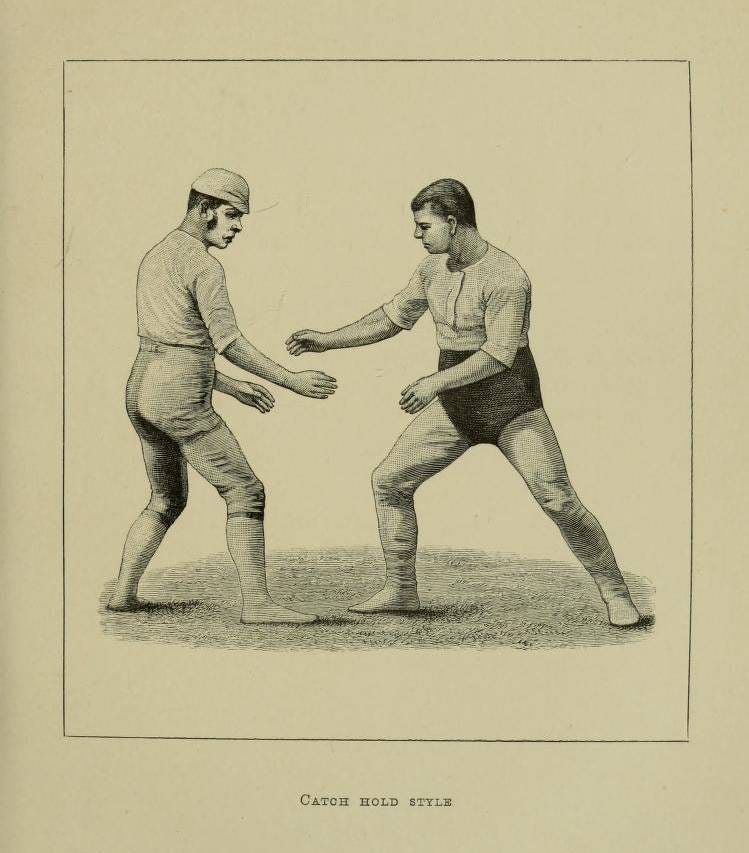
Now, because these contests aren’t designed to recreate the conditions of war, and in fact are acting as substitutions for it, they can vary to a great degree, and some can move toward the middle of the spectrum (medieval jousting comes to mind, which has been used to settle fairly large-scale legal and economic disputes, not to mention Paris and Menelaus agreeing to fight one-on-one to prevent the continuation of the Trojan War). Because of this wide variety of forms that a contest can take, no two forms of even one distinct activity like wrestling will be the same, as the rules for that alone can have potentially limitless variations. The way men wrestled in Egypt was almost certainly different from how the Ancient Greeks or Romans did it, and the “Greco-Roman” wrestling that we know now is a purely fictitious 19th-century reconstruction, probably based on a few different extant folk styles. Meanwhile, the “catch-as-catch-can” form of wrestling that developed through the 19th century British carnivals, and which later formed the basis of today’s collegiate as well as “freestyle” wrestling, is its own separate ball of wax — and we’ll discuss it more in a bit.
The point here is that while we can expect men to fight, and it is entirely natural that they will, there is rarely something that we might consider a purely “natural” fight. In the context of war, combatants will use external objects like weapons or armor, which means that oftentimes a culture’s level of technological advancement will determine the victor. In such a situation, any potential advantage can and will be seized including via deception or subterfuge. Alternatively, however, a fight will be designed within an honor-bound system, and thus a framework of agreed-upon rules will be imposed upon it externally, which means that there will always be some kind of artificiality to it. So, in αγων, there are too many rules, while in πόλεμος, everybody’s always cheating!
III. The commercialization of violence as a driver of technical skill
When the nineteenth century finally came along, something happened that was rather unique within human history: commercial market forces created a reason to develop a new style of fighting in which matches could take place as a spectator sport with a system of rules that allowed for an ongoing series of events featuring genuine strangers who had no prior conflict. To survive in a market system, these sport matches would require the potential for any successful fighter to return and fight some more (in other words, no lethal stakes or brutal injuries could be allowed). And if the sport proved profitable enough to survive as a commercial entity, then there would be a reason for a successful fighter to pass down his techniques to a group of students, so that his system could attain some continuity. In Great Britain, these conditions arose through the traveling carnivals in which catch-as-catch-can wrestlers first proved themselves. Catch wrestlers evolved and innovated their techniques by taking on amateur volunteer fighters (like farmers or millers) from a diverse array of crowds, which means that the catch wrestlers had to constantly learn new ways to subdue their opponents, both big and small, in order to keep issuing open challenges and keep the carnivals profitable. The more challengers there were over time, the greater the wealth of experience.
Then, throughout the 20th century, the legendary Gracie family evolved the techniques of Brazilian jiu-jitsu in a similar fashion, through a series of “vale tudo” (anything goes) matches, which were designed for spectators and often performed in Brazilian circuses. BJJ slowly began to incorporate more maneuvers found in other martial arts, including catch wrestling, which had a particularly strong impact on it (e.g. the “kimura lock” is named after Masahuko Kimura, who defeated Helio Gracie using what was really a double wristlock in wrestling).
The technical superiority of wrestling and BJJ, in other words, required a culture of mass entertainment and commerce to properly grow and develop. But as these superior martial arts developed through the commercialization of fighting, we were all forced to demystify the martial arts in a certain sense. Under these new conditions of cross-discipline combat, all participants were now forced to perceive the value of, say, a double wristlock hold, or to recognize the variety of submission holds available from a closed guard position, in which a grappler is lying down on the mat with both of his legs wrapped around his opponent’s waist. Spectators, meanwhile, could no longer nurture the illusion that there are secret mystical techniques from far-flung areas across the world, waiting to be discovered (i.e., the premise of the Street Fighter video game franchise). But in another sense, one could argue that the commercialization of spectacle combat further mystified fighting by creating the imaginary pretense that a participant involved in a BJJ tournament is engaging in a “real fight,” something more “legitimate” than a karate tournament, and thus will be more prepared to hit the streets and take on the world — a world in which the switchblade and handgun both exist.
I realize that this last point may seem a little too pretentious; maybe a bit too “French.” It is well-known that vale tudo fights were quite brutal, as were the fights in the old English carnivals, so who the hell am I to accuse these grapplers of trafficking in artificiality? But then again, recall the videos you’ve seen on WorldStarHipHop in which a group of, say, three or four feral degenerates will follow some unsuspecting victim as he walks down the street. They loudly indicate their intentions to maul him, he turns around, and he then uses his Brazilian jiu-jitsu skills to initiate a single-leg takedown on one of them. It works, he gets ready to “ground and pound,” and then, just as luck would have it, the others proceed to stomp his head in unceremoniously while the cameraman yells, “World staaarrrrrr!!!” These conditions are about as “real world” as you can imagine, and BJJ is utterly useless in them.
Then, if we zoom out a bit and examine the nature of war throughout history, it slowly becomes clear that the conditions and exigencies of war actually, if anything, prevented something like BJJ from being created. The most obvious demonstration of this principle can be found in the original jiu-jitsu from which Brazilian jiu-jitsu takes its name. Far from a distinct fighting style designed for tournament play (the term “jiu-jitsu” didn’t even show up until the seventeenth century), jiu-jitsu originally evolved as a discipline that could allow unarmed samurai to defeat armored opponents. Since strikes against armor don’t work, practitioners realized that pins, joint locks, and throws would be the best way of neutralizing an enemy. There was simply no room for something like lying down with your legs wrapped around an opponent’s waist (i.e., putting him in full guard) and then spending about a minute trying to set up for a submission. Such a tactic would get you killed in war, and so it makes sense that Brazilian jiu-jitsu would only emerge under the more controlled conditions of spectator sport combat.
Obviously I wasn’t alive during the Sendoko or Edo periods of Japan, but without having researched a ton into the matter, my suspicion is that jiu-jitsu techniques were taught knowingly as a last-resort method for unarmed samurai, and it was understood by pretty much everyone that its chances of working as intended would be pretty low, at least if the opponent is still armed. It’s like learning CPR and mouth-to-mouth resuscitation. The chance of CPR reviving someone whose heart has fully stopped is also quite low, but you do it anyway in the off-chance that it could save a life.
Anyhow, if my train of thought is correct, then there is certainly something interesting in the way that the conditions of the modern marketplace (you know, capitalism) have the tendency to drive technical ability within old — extremely old, utterly ancient — human affairs by essentially turning them into commercial products and spectator events. This is not only true for violence, but also for dance. It is even true for the sex act as well. It is also true for music, since jazz evolved within a commercial enterprise of 78 RPM record production, which led to a demand for musical virtuosity within the context of improvisation — something that simply never existed in previous forms of music, which were guided by religious/metaphysical principles and thus practiced under certain stylistic constraints. But even though the marketplace can drive technical prowess, this does not always elicit respect from the intellectual classes. During the 1990s, the UFC (the world’s biggest MMA federation) was regarded contemptuously as “human cockfighting,” resulting in multiple state and television bans that nearly destroyed the company. But then, thirty years later, a UFC event took place on the White House lawn. It will be interesting to see how MMA is regarded another thirty years from now.
I am not very knowledgeable about the history of jujutsu myself, but it is said that the various martial arts from the Sengoku period, which are considered the roots of jujutsu, were developed on the assumption that weapons would be used. They seem to have been primarily intended for combat at distances closer than the effective range of a sword. In particular, a martial practice known as kumiuchi had as its ultimate objective the decapitation of a subdued enemy warrior with a dagger.
When the Edo period brought an end to large scale warfare, these martial arts began to emphasize their role as forms of spiritual and moral cultivation. During the interwar period, they became intertwined with nationalism, eventually evolving into the various forms of budō practiced today.
In Japan, combat sports still retain strong mystical elements, and as a result, competitive and commercial aspects have not developed as extensively. Professional sumo is an exception, although its organizational structure remains remarkably premodern.
Event today, the belief that traditional martial arts centered on apprenticeship and master disciple relationships are spiritually superior to disciplines such as MMA remains widespread. The idea that mere fighting ability is insufficient can also be seen influencing manga and other forms of popular culture.
I've thought about the tail end of the cycle you sketched out for while under the name of "sportification". This is where a system of fighting that developed to be used in multiple contexts of varying lethality, collapses merely to the least lethal version of sport. Part of the traditions even seem to focus on determining what context your entering into, and escalating accordingly.
My favorite example was and probably always will be french foil fencing as derived from the smallsword tradition which itself is a rather strange offshoot of more generic european swordsmenship. Comparing modern olympic foil to the smallsword is similar to comparing chihuahahas and foxes, and to run away with the metaphore the smallsword compared to the longsword is like comparing foxes and wolves.
The front half of your cycle gives me pause however, that commercialization creates the initial complexity. European swordcraft seemed to be driven by spectacles rewarded by honor rather than gold. Here I'm not only referencing french noblemen dueling with smallswords, where winning meant winning the duel with impressive skill to gather more noteriety, but also german fencing guilds.
I'd love to hear of what books you were going to crack to dive into the subject.