

You’re reading Steam Calliope Scherzos, a blog that synthesizes media ecology with nonstructuralist semiotics to discuss various matters.
I recently read all of Can Life Prevail? (2004), published by the company formerly known as Integral Tradition Publishing, now Arktos. It is the biggest collection of Pentti Linkola (1932-2020) essays translated into English to date, mostly covering his writings from the 1990s up to the early ‘00s. I had been familiar with Linkola for about fifteen years now, and I had read some lengthy excerpts of some of his most radical work in the past. He also has plenty of interesting YouTube videos about him, having been something of a national celebrity in Finland throughout his life. For instance, in this mini-documentary from 1988, he talks about the ideal society that Finland could become, if only the world could depart from its collective drive toward mass suicide:
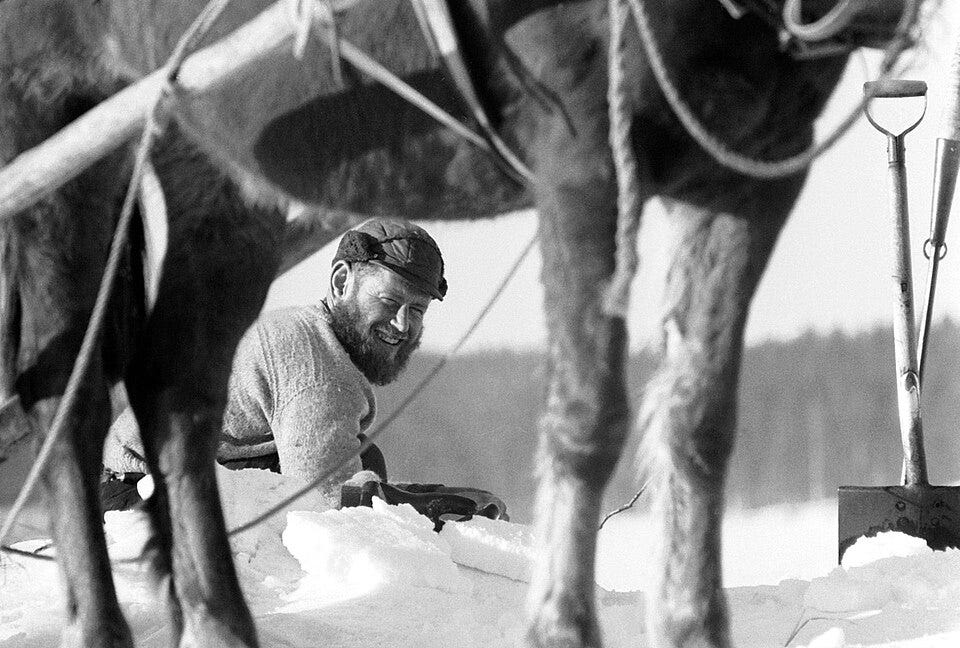
It isn’t really necessary to watch it — after all, you’re here to read! — but it gives you a sense of what this guy’s deal is, with a pretty good synthesizer soundtrack to boot. The Linkola presented in that video is an outdoorsman, he’s an ecologist, an amateur ornithologist, a fisherman by trade, and someone with a serious belief in halting all technological development, severely depopulating the planet so that only about a million people remain in Finland give or take, and making sure that what’s rest of humanity can co-exist with nature in a sustainable fashion for the rest of time. We’ll discuss some of his more radical views in a moment. But in any case, the video doesn’t lie: that really is who he was during his time on earth.
Linkola’s commitment to ecology has always been interesting to me, but nonetheless, I had never actually read the entire collection of his essays until around last week. Instead, he has always lurked in the background of my thoughts as more of a symbol than a real thinker, like a sort of druidic specter, hovering around all discussions of mankind and its collective future. It would be nice to see more of Linkola’s work translated, since that particular book came out over twenty years ago, and it still holds some interest here in the English-speaking world. And more translations would be justified, given the genuine passion he demonstrated throughout the course of his life. You could accuse Linkola of many things, but disingenuousness would not be one of them. Linkola wasn’t just a guy who spent a few months as an activist and then promptly used that as an excuse to be an “edgelord” on social media. In fact, he didn’t have the internet at all and wrote everything on a typewriter. He’s a special example of someone who arrived at viewpoints that most would label far-right or “fascistic” due to his own privately worked-out principles of conservationism rather than the joy of transgression, exhibitionism, or the feeling of the ecstatic — motives that thinkers such as Bataille, Adorno, and Eco saw as crucial to understanding the fascistic impulse.
As an amateur ornithologist, Linkola was quite accomplished, compiling 65 journals from 1945-2016 that documented species behaviors, nest conditions, nestling counts, and population trends. All of this data has amounted to a genuine contribution to scientific research and species monitoring. Particularly rich has been his documentation of the Lesser Black-Backed Gull. He also published two books on birds, one in the 1950s and the other in the ‘60s, both of which were quite well-received. As an activist, Linkola established the Finnish Natural Heritage Foundation in 1995 for the preservation of Finland’s old-growth forests, and it remains a respected organization to the present day. He also won the Eino Leino Prize, a Finnish national literary award, in 1983 for his 1979 book Toisinajattelijan päiväkirjasta (“From the Diary of a Dissident”). For these reasons, he has been appreciated in Finnish society as perhaps an eccentric but ultimately sincere and well-intentioned figure, someone whom two very different people could like for altogether different reasons.
And as I expected, Can Life Prevail? reflects Linkola’s lifelong passions and concerns. Most of the book is filled with discussions on topics to which he devoted considerable personal time in a hands-on way. Section II is filled with short essays mainly about deforestation. Section III is dedicated to essays on animals, with plenty of discussion on the population trends of various species of birds, many of which I had not even known about. It also contains plenty of criticisms directed towards animal rights organizations for having their priorities backwards. For instance, Linkola is critical of groups that defend the mink and the raccoon, two mammals that he feels are ravaging the local ecosystem. He also is highly critical of the importation of cats as pets into Finland, since they are top-notch predators who inherently threaten various native Finnish flora and fauna. He even goes so far as to criticize laws that specifically punish people for drowning and killing them, since such laws are anthropocentric in nature insofar as they treat cats as special companions to humans and ignore the real threat that they pose to the less protected aspects of the environment.
When you step into Linkola’s world, you are stepping into the world of a thorough stocktaker. Linkola regularly gets up-close and personal with the subjects about which he writes, and so he is certainly no armchair critic, but you also can sense that when he speaks about the population trends of the animals and plants he wishes to preserve, his point-of-view is rather different from when he walks among them in the forests and streams. Think of it this way. It’s deeply unpleasant when a deranged teenager violently drowns a single cat and then shortly afterwards you see its corpse and imagine its warm body struggling for air until its last gasp. But when you assume the scientific point-of-view, the gaze of the wizened gardener, you realize that this act of perversion amounted to very little in the grand scheme of things. The cat population is already too high, sadists will engage in acts of sadism towards all kinds of animals, and so it’s for the best that the sadist killed a cat rather than, say, some ground-nesting passerine bird whose existence is in greater jeopardy. All of this makes sense logically, and, of course, it is a perspective that does not occur to any animal in the natural world. The animals simply do what they are instinctively inclined to do while nature responds.
But humans can sustain this duality of perspectives, especially for those accustomed to the wild. In the Roman pantheon, Diana is the goddess of wild animals and the forest, but she is also the goddess of the hunt. There is no contradiction in that, since the hunter’s job is to prune the population as other natural predators do. Linkola actually discusses the subject of hunting in one short piece, since as a teenager, he was mortified by the hunters who would kill water birds such as ducks and fowls, and he was particularly incensed by the hunters who will target endangered birds of prey and have them stuffed. Over time, however, he was pleased to find that the hunting and wildlife game organizations started recruiting biologists for consultation on which animals to hunt, and so gradually, Linkola found common cause with these hunters against the much bigger problems of urbanization, corporate farming, and deforestation. As he puts it, “When the fauna of Finland was forced to adapt to an altered environment, and only a few animal species survived while many others disappeared, environmentalists and hunters often found themselves on the same side against a common enemy.”
The manner in which the ecologist can tolerate something that might bother him personally — like violence against animals to whom he is personally attached — is quite understandable when you recognize that he’s capable of internalizing numbers and statistics, and thus allows “the big picture” to guide him. Most of us do this same exact thing routinely to some extent. Take rain, for instance. Most people don’t like rain on a personal level because they don’t like to get wet. But when it does rain, it isn’t unusual to hear someone say, “We sure do need that rain!” because he can read a newspaper and understand that the region is in danger of a drought, even though that same man has no plans of walking around in it. Or consider those adorable little sea turtles that march towards the sea as hatchlings. Most of them do not make it to the sea, since crabs, birds, raccoons, and other predators will intercept them mid-journey. In fact, technically, only about one in a thousand sea turtle hatchlings survive to full adulthood. And because these turtles are so cute, we might be inclined to want to help them. But marine biologists and scientists in adjacent fields will then assure us that this would be wrong, since an excess of sea turtles would distort the ecosystem, and so we quickly recognize the validity of their point. Again, that’s a clash between what our instincts tell us and what our higher sense of numeric reasoning says. Sometimes, we grow so accustomed to this higher reasoning that we can allow it to recalibrate our instincts, thus eliminating that psychic clash altogether. But whatever the extent of our experience with this kind of reasoning, we all must assume the role of nature’s stocktaker at some point.
If we want to understand Linkola’s perspective, we must simply take that kind of stocktaking logic that we all use on occasion — the kind in which numeracy subdues the passions — and amplify it a thousandfold. That’s basically Linkola’s thought in a nutshell. In the clash between sentimentality and cold logic, Linkola will consistently allow the latter to prevail every time, even when it comes to matters that concern our own species, the humans. This is where things get a bit hairy.
So, how hairy does it get, exactly? Well, luckily, at the very end of Can Life Prevail?, Linkola provides for us a rather specific program for limiting human demographic growth and preventing climate change from happening along with other ecological disasters. He wrote that particular essay in 1999, a time in which he was starting to mellow out a bit, and he even acknowledges that he is inhibiting himself considerably in an attempt to be humane. Thus, his proposal is “probably too soft.” But in it, he suggests a few things. Among them are a strong central government that gives people earned licenses to breed rather than allowing them to do it unsupervised — and even among those who have such a license, only one child per woman is allowed. Beyond that, nutrition, vitamin, and hormone levels would be rigorously controlled by this government, especially among the adolescent population, which would eliminate obesity and the wasteful expenditure of resources that comes with it. All fossil fuels including peat would be abolished immediately. Trees would be made to grow from 70 cubic meters per hectare to about 400, which would result in some very thick forests pretty much everywhere. Corporate farming would end, and farming would be done only by small units with all farming machines abolished. Private use of cars and motorboats would be abolished, too, while long trips would only be available through organized and infrequent public transportation. All foreign trade worldwide would be reduced to a minimum, and the main imports would be metals not native to Finland (or whichever country, really) along with salt, since salt would be required for food preservation, since refrigeration would end. (Incidentally, it is interesting to see that he doesn’t want a one-world government, yet you wonder how every country would spontaneously concede to such demands otherwise, given that every individual government is always trying to gain the advantage over its neighbors.) Anyways, all air traffic would cease while most ships and icebreakers in coastal harbors would be demolished. Most businesses would come to an end, new homes would cease to be built, and stock markets would be shut down while banks are used strictly for storing money. Education would be a huge deal, since Linkola envisions a sort of liberal arts culture similar to the kind depicted in Hermann Hesse’s Glass Bead Game (only with more outdoor survival training), since he doesn’t want education used for commercial or technological purposes. Oh, and computers and the internet? Throw ‘em all off a cliff! He also would ban all “trashy novels” and smutty works of art along with all drugs, including tobacco. As for alcohol, it would only be sanctioned for large festivals. I have no idea what that last part has to do with saving the environment, but hey, whatever.
Of course, such a plan if implemented worldwide would result in the death of billions, and Linkola knows this all too well. By 1999, he wasn’t talking so much about that unpleasant aspect of his vision, but he was quite open about it during the 1980s and at least the first half of the 1990s. Although I haven’t found these quotations myself, online discussion from Finns indicate that he has talked openly about how, say, the machine gun is a wonderful invention because of how quickly it dispatches large swathes of people. Or how war is excellent because it keeps the human population in line, but its main problem is that it doesn’t remove enough women, since they are the primary source of fertility. In Can Life Prevail?, his most incendiary quotations spanning his entire career are largely absent, but there is one that sums up his perspective pretty succinctly: “When the lifeboat is full, those who hate life will try to load it with more people and sink the lot. Those who love and respect life will take the ship's axe and sever the extra hands that cling to the sides.”
That quote deserves close attention, since you’ll notice that he’s making a clear distinction between life qua life and not specifically human life. The “lifeboat” is like Noah’s Ark — it’s got a little bit of everything, and too many humans will mess it all up collectively. Linkola’s goal therefore is to preserve not just human life, but the earth’s overall biodiversity, and so he reaches a clear and distinct conclusion: human overpopulation is its greatest threat. Most of his pie-in-the-sky political visions come directly from that principle. At the time when he was making his most extreme claims about the need for human depopulation, the idea that the earth was too full was still quite fashionable, in large part because of Paul Ehrlich’s massively successful The Population Bomb (1968), a neo-Malthusian argument that overpopulation would run out the world’s food supply and cause massive famine, resource wars, and ecological collapse. Ultimately, Ehrlich’s claims in that book and in writings elsewhere turned out to be spectacularly wrong. For some examples, he argued that hundreds of millions would starve to death in the 1970 and ‘80s (they didn’t), he predicted that the U.S. population would only be 22.6 million by 1999 (it wasn’t), and he lost a bet against the economist Julian Simon that the prices of five metals — chromium, copper, nickel, tin, and tungsten — would rise due to scarcity throughout the 1980s, when in fact they fell.
However implausible his predictions may have been, even during that time, the intensity with which Ehrlich made his claims was enough to convince a huge amount of people that overpopulation is indeed a serious problem, and this attitude persisted for quite a while. I grew up in the 1990s, and it was brought up quite often even then. Ehrlich’s presentation of the problem differed vastly from Linkola’s, however, since Ehrlich framed the matter in anthropocentric terms. He was mainly concerned about problems that would affect humans, not plants or other animals, though he did make a few points about the broader green world. But Linkola would have preferred it if Ehrlich’s predictions had come true. If the Earth had severely depopulated due to famine, he would have said “hienoa kuulla” (“great to hear”) with great Finnish sobriety and gone on his way. Instead, crop-growing initiatives like The Green Revolution disproved Ehrlich’s thesis but largely bolstered Linkola’s concerns, because even though it allowed the human population to grow from 3.5 billion to over 8 billion, it also created many real problems such as heavy fertilizer/pesticide use, groundwater depletion, and monoculture vulnerability. Essentially, the solutions to the Malthusian problem didn’t necessarily disprove the basic theory, but they did manage to kick the can down the road, as it were, by spreading out the problem into different areas. So, while food remains in abundance to the present day, industrial agriculture has run into soil, water, biodiversity, and climate ceilings that have each become distinct ecological crises. Linkola, thinking only with the mind of the master stocktaker, made objections that were basically immune to the counterarguments that (justifiably) defeated Ehrlich and his followers.
But the “population explosion” thesis didn’t only go out of fashion due to Ehrlich’s bad predictions. Bad predictions aren’t enough to sink a theory. Consider climate change, for instance, which has generated its own share of bad predictions. Here are some: in 1989, Noel Brown (the director of the New York office of the UN Environment Program) predicted that entire nations would be wiped off of the Earth by the year 2000. In 2007, Arctic researcher Wieslaw Maslowski projected that the Arctic would lose its summer sea ice by 2013. And in 2008, Al Gore (climate change activism’s biggest voice at the time) claimed that the polar ice cap would be gone in five years. None of these things happened, yet the basic theory remains right, and people still believe it, though it seems that concerns about it have waned in recent years. In any case, the other indispensable reasons for why the concerns regarding overpopulation went out of fashion are that, firstly, when the fertility rate started to deplete in the first world, people started to feel the economic effects, and educated elites collectively decided that it’s better to continue populating their respective countries so that the GDP lines would continue to go up. But the second reason is that overpopulation simply leads to too many sensitive questions that most western environmental activists are too soft to confront.
For Linkola, climate change is a serious problem, as we’ve seen. But then again, it comes mainly as a consequence of overpopulation, and thus the latter is the more fundamental problem by far. Once you start seriously considering how to halt the accelerated pace of climate change — and this would entail looking up things that help you gain a sense of proportion, like, I don’t know, how much energy a single two-hour jet flight consumes versus a year’s worth of running a dishwasher — then you can gradually appreciate the scope of the issue, and you start to realize that namby-pamby little half-measures like incandescent light bulb bans simply aren’t enough, not even close. You start to realize that the issue is, above all else, an ever-present excuse for neuroticism among upper-middle class first-worlders rather than something that the industrialized world will ever be willing to confront. If the possibility of reducing the population of America ever comes up, people immediately insist that America needs more people because it will grow the GDP, and a high GDP is necessary to defeat the looming threat of the Chinese, or whomever. OK, well, then you can modify all the household appliances that you want, but if you up the fertility rate, you’re going to get more energy expenditure. Period. In other words, economics and the need to preserve first-world benefits will always trump the concern of excess population and thus climate change. In fact, most things do.
Consider immigration from the third-world, for instance. That’s something educated elites in America love for a combination of economic and ideological reasons. Now, if your top priority is lowering the carbon footprint and reducing fossil fuel emissions, then this topic should be a no-brainer. If you allow immigrants from third-world countries (ones that use comparatively few resources) to move into first-world countries, then they will leave a larger carbon footprint. And if they are known for their high fertility rates within their native countries, then they will have more kids in the first world, and their carbon footprint will grow all the more. Duh! This is why the Sierra Club initially favored limiting immigration when it was first founded in 1989. But then, it decided to adopt a stance of neutrality in 1996, and then, in 2013, it fully supported mass immigration. It isn’t that they discovered something new about immigration that they didn’t know from the beginning. It’s more that they learned their place in the progressive issue hierarchy, and it’s not a particularly high one.
Meanwhile, the biggest climate activists eventually focus on other topics or fail to demonstrate any level of personal commitment. We all know about the charges of hypocrisy against Al Gore considering the amount of jet flights he was taking while warning everyone about climate change. But more recently, Greta Thunberg — the young activist who built her name on climate awareness — has switched over to generic, all-purpose progressive activism, particularly involving the Israel/Palestine conflict, while she has mostly gone quiet on climate. Toward the end of his life, when Linkola was asked about Thunberg, he said, “I follow what is being said about her very closely. She is a wonderful girl, even in a slightly crazy way. We will see how long she can keep fighting.” It’s as though he knew deep down that she wouldn’t last.
Linkola may seem monstrous in his thinking, and for that, he has attracted the charge of “eco-fascism” along with the public disavowal of many environmental activists all over the world. And since his death in 2020, few have come around to his thinking. After all, he spent his life openly maligning liberal democracy as little more than a pretext for the masses to indulge in their selfish (and wasteful) whims, he was a strong advocate of eugenics, and he advocated sterilizing people by force rather than choice. According to one article from 1985, he actually gave a speech telling the Finnish Green Party to learn from the Nazis and cultivate their discipline. These are all things that developed countries simply cannot do at this point in time. But just as baffling to many was his willingness to sit by and watch as others die, something contrary to the Christian sensibilities of both America and Europe. That willingness in particular is something I’d like to focus on as I wrap up this discussion, and this interview here is particularly useful for understanding his perspective:
I’ll go ahead and transcribe the key part, so you don’t have to watch.
Host: So if in, say, Ethiopia or Somalia there’s continuous famine, should we let them, like… die? Just die there? Or…
Linkola: Yes, most certainly. It doesn’t concern people living on the other side of the globe in any way. Just as little as any Finnish natural disaster is the concern of anyone other than the population that lives in that area.
H: Yes, but… in a way, it can’t really not concern us. They bring it here to our borders. How can we close our eyes and ears to it?
L: “How can we”? I’d rather ask instead: “can we close them”? Or rather “should we” close our eyes. Let’s close those eyes and ears.
H: But in a way, if we just let them die, if we follow on the TV their slow or fast deaths…
L: That’s also unnecessary.
H: To follow it on TV?
L: Yes.
H: So just switch the channel and watch entertainment?
L: Yes, but rather, I’m talking about the television itself. I mean, there are other ways to fill up these living hours.
H: So we shouldn’t even… we shouldn’t even watch it, or acknowledge that it’s happening at all?
L: Yes, what good would that supposedly lead to, then, to watch such unpleasant things?
…
At first glance, this exchange may seem pretty quaint, but I think it illustrates something crucial. Linkola was perfectly willing to present himself as a spokesman for the environment on TV and the radio, but he was not a man of the electronic world. He was a man of the print world; that was the virtual environment that he inhabited. He wasn’t going to waste his time looking at video footage of starving Africans, or war casualties for that matter, or victims of any other atrocities. He was, in fact, quite clear about his preference for the written word — the naked, unaccompanied word — over all other vehicles of information. In his sketch of a perfect society that we discussed above, he actually says so on no uncertain terms (my emphasis),
Afternoon newspapers and pulp literature will be abolished. The number of pages in newspapers will be reduced by removing all advertising, making all announcements consist only of text, and banning the repetition of any item of news in the same publication.
So, no repetition— if you hear something once, that’s all you need — and no photography. If you hear that thousands are dying per day amid a particularly gruesome genocide over in Swaziland, you take the bare information, and that’s all. But of course, if you were to regularly see videos of what’s happening, including amateur videos that people take using their cell phones, your understanding of the situation would vary wildly, depending not only on the content itself but also the ideological context and distributive infrastructure through which it is presented. It is actually hard to overstate how much the manner in which information is delivered to us can affect our view of what’s taking place, even if it presents “objectively” the same facts. Any given medium can completely alter the meaning of famine, war, and other forms of devastation.
The novel coronavirus of 2019 serves as a useful case study. In an environment without the existence of a daily newspaper, people would have just said, “Wow, it sure seems like a bad flu season this year,” and the death toll number would never have haunted them. They wouldn’t have even known anything particularly unusual was happening. Under the conditions of a daily newspaper without television, people would have had some idea that a new virus is harming people, but the awareness would never have been so visceral. It would have been confined mostly to a realm of abstraction, and the most intelligent would have been able to recognize that the overall death toll is spread out evenly among the world populace rather than concentrated and malicious, as with a genocide or prolonged massacre. It never would have felt real. Under the conditions of the internet and television, however, the constant broadcasting of the disease’s worst and most anomalous cases engendered a sense of paranoia and fear among most of the international citizenry, which led to a collective and unprecedented hubris, and in turn, almost certainly worse health problems (including mental health) than there would have been had everyone simply conducted their business as usual. We know this because no matter what lockdown or mask regulation measures each country took, their death tolls all wound up being comparable, and there is no way to accurately guess at what measures were taken based strictly on the death toll of each country. Linkola’s position — let the elderly die! — actually would have been the correct one, whatever we think of his motives. The cerebral coldness of Gutenberg man certainly has its advantages.
But it isn’t just Linkola’s emotional detachment that makes him a man of the printed word. It is also his nationalism. When I say “nationalism,” I don’t mean it in today’s disparaging sense of blind jingoism but rather more in the sense of one’s primary orientation to the rest of the world. Linkola is a nationalist in the nineteenth-century sense of the word, back when nationalism meant tolerance rather than prejudice, since it implied the surrendering of allegiance to one’s small clan or tribe (like the Welsh, the Manx, the Jutes, the Goths, or the Saxons) in favor of the larger, more abstract secular governmental body, the nation-state. Whenever Linkola writes about matters concerning all of humanity, he always centers the discussion specifically on Finland. Thus, when he seems to be writing about what all of mankind should do, he is in fact only writing about what the Finns should do. The implications for mankind on the whole are clear, but Linkola is nevertheless consciously speaking to an extended audience of only those who read Finnish.
The age of print brought about the condition of nationalism by elevating vernacular languages and thereby collapsing social distinctions, and the kind of nationalism it represented was about the closest humanity will ever get to real egalitarianism. The electronic era, by contrast, finalized the invention of the global community (or “the global village,” “the global theater,” or whatever you want to call it), but in doing so, it also engendered a new sense of tribalism that has brought mankind back to the clannishness and even caste rigidity of earlier times. Now, in the case of Linkola, a strange disjunction emerges wherein he is clearly writing about humanity as a total unit, but his thinking is firmly couched in the national question of Finland, and thus the harsh realities of international conflict or even man’s innate greed never seem to occur to him. Although his views are rigidly hierarchical and he does believe in authoritarian rule, the society he dreams of is materially egalitarian, since commercialism disappears, primitivism reigns supreme, and wealth largely means nothing. His leaps from the individual to the nation to the entire planet are eerily without any friction: the nation-state is the center of his phenomenological universe. Therefore, his world isn’t as politically extreme as people think because it actually lacks a political element in the first place.
Which is to say, Linkola is a utopian thinker, and utopian thought has been on the decline since the advent of electronic media. Just think: do we have a vision of a perfect society anywhere near as broadly inspiring as the Utopia of Thomas More, the New Atlantis of Francis Bacon or the Communist Revolution of Karl Marx? Of course not. The utopian vision is as permanent as the fixity of the written word, and our current time is one in which the written word is disposable and ideas reside in a state of constant flux. As John Miles Foley has observed, under the conditions of non-literate oral communication, the ideas that survive are essentially the “fittest” — or so it seems at the time, in any case. Under the conditions of literacy and especially print, however, the ideas that survive are instead the “fixed-est” — that is, the most apparently systematic, true in principle, and destined to outlast any contingency. To be sure, the digital age has extended and even broadened some consequences of the print world, but in this regard, we have gone back to the realm of orality. What makes Linkola so interesting (to me, anyhow) is that his perspective is one in which fixity is the goal, no matter the cost. Whatever flora and fauna currently happen to exist in the woods and marshes of Finland, that is how it must be until the end of time. No species should go extinct, and no plant should disappear. Yes, the numbers of each population must shift around, but they must do so only to ensure maximal chances of survival for each and every organism, including humans. Every single species is a raw material, and every material must have its appropriate stock in nature’s vast inventory. The existential condition of every last aphid, shrew, and shrubbery hangs in the balance, and every consideration must be made so that they all can remain in perpetuity, that is, until they finally reach the finish line. And where is that finish line, exactly? No one knows.
As I said near the beginning of this post, Linkola will often enter into my thoughts when I need to think of “the big picture.” Should we do another lockdown? Or should we let grandma die? “The latter,” I think to myself, paying tribute to that morosely countenanced Finn. “We must let grandma die.” But despite my respect for his gift for intellectual detachment, personally, I can’t get behind Linkola’s vision. I can certainly respect it, but I must confess that I lack the moral instincts of a conservationist. As much as I agree with most luddites about the alienating aspects of modern technology, there is another, perhaps perverted sensibility that lives within me. It appreciates that the human species has elevated itself to levels of symbolic fluency that no other species has reached, one that sets itself far above and beyond anything the rest of the animal kingdom could ever accomplish. It appreciates that hanging above nature’s biosphere, red in tooth and claw, there is a distinctly human noosphere of wild imagination and grandiose insolence, one that abides by its own laws, and in very the act of creating and sustaining it, we humans have asserted our dominance over the entire planet. This perverted sensibility that rests within me is actually quite OK with the likelihood that our unique and bizarre species will continue to drain every reservoir, plunder every forest, exhume every hill and valley, and deplete every resource available, propelling itself onward, ravenously, until its ship of fools floats off into uncharted waters and finally sinks into the abyss, taking a downright horrific number of innocent plants and animals along with it. For whatever reason, I have made my peace with all that. I simply lack the deontological ethics of Linkola, a man who admirably respects biodiversity but then reaches the inexplicable conclusion that whatever is, must be forever. It is baffling to me that the same man who possesses the maturity to recognize that the death of a billion humans is just a slippage in man’s terrestrial career will then turn around and act as though the extinction of an obscure bird species, universally-reviled insect, or even yet-to-be-named plant amounts to some kind of grand tragedy. Does nature not possess the ability to forge new life? Does she not possess her own organizational logic? Is she really so fragile that she must depend upon mankind’s managerial hand for guidance? Could she not simply extinguish humanity, drunk on its own arrogance, and begin fresh once more? It seems to me that whatever noise he might make to the contrary on occasion, man will never relinquish his voracious will, slow himself down, and adopt the role of the thoughtful zookeeper, the iron gardener, or nature’s dutiful stocktaker. It seems to me that humans, for better or for worse, have other plans in mind.
All the same, however — despite my own differences with his perspective, Pentti Linkola gets my respect for at least being one of the only men to stare at the problem without flinching.
edit 8/18/26: some minor typo corrections and stylistic fixes
8/20/26: some more stylistic changes, more grandiosity and hoity-toityness in the final paragraph