
Pedo-mania!!!
Or, Language Is Not A Fiat Currency (Revisited)


You’re reading Steam Calliope Scherzos, a blog whose ideas largely stem from media ecology and non-structuralist semiotics.
I.
A while back, I wrote a post about how language is not a fiat currency. It was a response to the oft-stated claim that if someone overuses some word in a sociopolitical context, then eventually its meaning will go away or become greatly diminished. When I was growing up, the claim was typically, “If people keep accusing us of being racists, then eventually the word will lose its sting, and no one will care about the accusation!” My contention was (and remains) that words don’t inflate in value through overuse that way, because language doesn’t work like a currency with its value determined through supply and demand under conditions of scarcity.
So, how does language actually work? Well, consider all the people who accuse the mildly insensitive of racism rather than reserving the word for only the hateful bigots. When a word starts to cover more and more semantic ground, it ideologically reinforces the importance of the concept racism = bad. It doesn’t particularly matter if the word is being used too liberally to maintain a consistent definition, because that’s not really the point. Its persistence and ubiquity serves as a reminder that racism is the worst thing there is, and therefore the worse the racism, the worse the person.
One might object, what happens when you’ve used the word “racist” to describe totally normal or relatable thoughts and feelings for long enough? What do you even say when it’s an actual racist who blatantly discriminates against blacks in the workplace? Well, then it’s simple: you call him a racist. Maybe you throw some qualifier in there like “literal” or “actual,” but that’s about all you need. When people make the accusation of “racism,” it’s like when a schizophrenic hallucinates something happening. If the schizophrenic then actually sees the real thing happening, he’ll typically say something like, “No, it’s real this time!” because some latent part of his mind actually does recognize the difference between reality and fantasy. So it goes for these overused words.
The basic idea of my post was that language doesn’t just have a signifying function but also a mnemotechnic one. If I’m constantly blathering about racist this, racist that, and all of my friends are doing the same, we’re reminding each other of what really counts in this life; what we need to stay vigilant against. We’re keeping our values at the forefront of our conscious minds. This is a function of language that we often don’t recognize.
Now, at the time I wrote that post, I focused on the word racist… right when it was starting to lose its power to affect public opinion. Of course, it hasn’t lost its power as an accusation, and it matters tremendously in academic, corporate HR, and legal contexts (such as when determining the motive of a crime). But in the court of public opinion, it has indeed lost much of its sting, particularly among Republican voters. So, how did that happen? Some will say that indeed the prophecies came true: people kept saying the word over and over again, and then finally its value inflated and it could no longer retain the same semantic punch that it once did. Much like the papiermark during the Weimar Republic, or the Hungarian pengő following World War II, the word “racism” finally hyperinflated and lost all of its power. Never mind that it is still incredibly powerful within certain milieux, particularly those whose inhabitants discuss it and think about it most often. Never mind all that.
But if you really do think that this shift in public opinion was all because of word inflation, here are some more plausible alternative explanations for why the accusation of racism seems to matter less nowadays:
The ideology around racism itself has shifted and become more politically polarized, with Republicans simply caring about it less in America. Although most people overall were supportive of Black Lives matter when it was happening from the years 2014-2020 (or at least that’s what they told pollsters), its memory has clearly grown more sour, with public approval between 2020 and 2025 dropping from 67% to 52%, while the number of people with actively hostile views toward the movement has grown. Similarly, from 2024 to 2025, Republicans who feel that black Americans face at least some discrimination declined from 66% to 55%. Skepticism towards DEI initiatives has also grown.
The gatekeeper institutions that are largely responsible for hurting people’s reputations over racism — namely, the ADL and the SPLC — have lost a ton of credibility, particularly among the left. Regarding the SPLC, founder Morris Dees’s personal sleaziness finally caught up with him. This is interesting, because progressives had been criticizing the organization’s financial corruption since the late 1980s, but Dees eventually was forced out of the organization personally for allegedly discriminating against nonwhite staffers and sexually harassing the young females. Meanwhile, the ADL has lost much of its credibility following the October 7th attack in Gaza, with progressive publications like The Nation subjecting them to strong criticism, while progressive campaigns against them like DropTheADL have formed. Without these gatekeeping (some might say “shakedown”) organizations to credibly monitor racism, there is less organized power behind such public accusations.
Social media has recently started allowing for more freedom of expression with Elon Musk’s buyout of Twitter and Mark Zuckerberg’s pledge to use less censorship across his social media platforms. This shift has perhaps signaled to people that what was once called “racism” is not so terrible and will thus elicit less negative consequences.
Crowdfunding seems to have proven valuable in disincentivizing people from “cancelling” people through viral racism accusations. The 2025 case of Shiloh Hendrix, who called a small child a racial slur for stealing from her child and was caught on video, has been particularly illustrative. While she is being prosecuted by the state for saying the racial slur, she did crowd-fund nearly a million dollars when someone tried to “cancel” her for it on social media. For many of her backers, the rationale was simple: send a message that when someone tries to organize an online mob to harass someone else, the mob victim will get paid lots of money by the mob’s ideological enemies.
And lastly, people now seem to have been distracted by a new bipartisan moral concern that isn’t racism…
II.
Ten years ago, back in 2016, the science-fiction author and blogger Vox Day posted this on his blog:
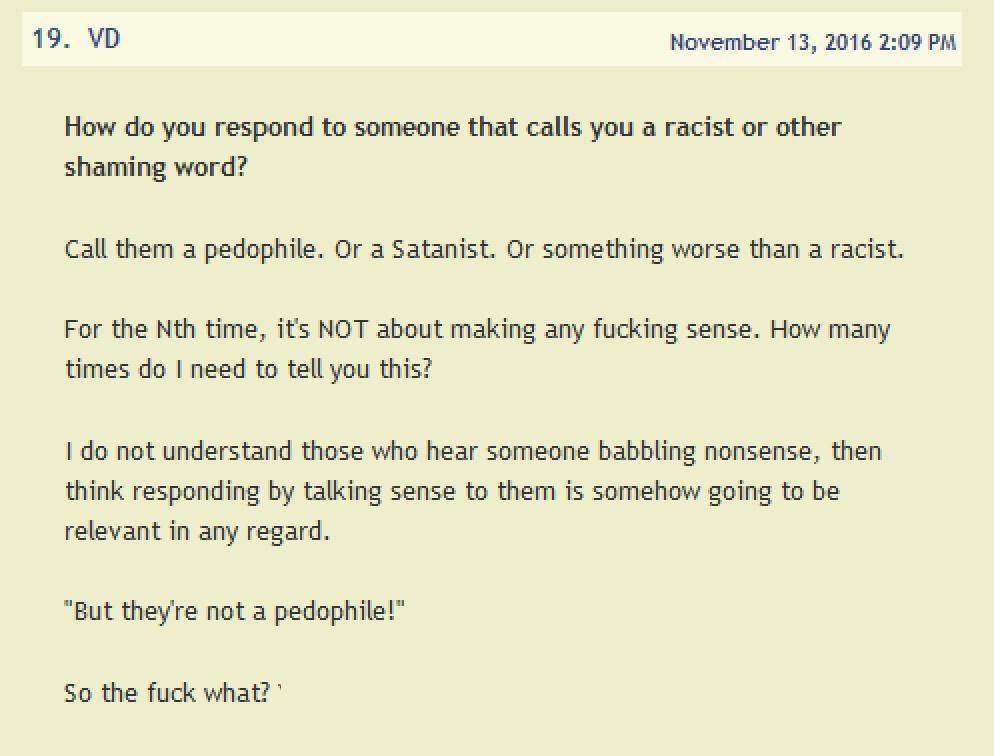
If they call you a racist, you simply call them a pedophile. After all, it’s something worse than a racist, and you need to show everyone observing the exchange that you’re always on the offensive. It’s how you “maintain your frame” in a confrontation and win the rhetorical joust. Doesn’t really matter if the accusation is true or makes any sense. Just go ahead and call them a pedophile.
OK… listen. Say what you will about his ethics, but Vox Day was conjuring up the American cultural zeitgeist for probably the next thirty years. At least.
In all likelihood, V.D. was inspired by the viral success of the Pizzagate conspiracy theory, which was starting to become prominent around that time. A widely-read Reddit post dated November 4 had alleged that Comet Ping Pong was involved with a child sex trafficking ring involving Hillary Clinton and John Podesta, and the theory had been cooking on the 4chan forum for at least a few days beforehand. Vox Day was reading the cultural moment. And again, whatever his faults, he pretty much understood what was on the horizon. Consider how the next several years went:
In 2018, a year after Mr. Day’s post, QAnon, or just “Q” for short, first emerged on 4chan, then quickly migrated to the 8chan forum, a somehow even less moderated version of 4chan. QAnon presented a theory in which a global Satanic pedophile elite was engaging in a worldwide sex trafficking as well as adrenochrome harvesting operation. Donald Trump, according to Q’s account, was a covert operative preparing to bring down this pedophilic elite via a series of military tribunals (for some reason, Q believed that most of the military officials within the deep state were morally unblemished, and only a few bad actors had already left or were soon going to leave).
In the summer of 2018, some boys from a soccer team got trapped in the Tham Luang cave in Thailand. Elon Musk claimed that he could hire engineers from SpaceX to build a miniature submarine to help rescue the boys. A British cave diver named Vernon Unsworth called this idea impractical during a CNN interview and accused Musk of engaging in a PR stunt. Musk responded by calling him “pedo guy” on Twitter. He later doubled down and referred to him as a child rapist in an email to Buzzfeed. There was no basis to these claims, of course.
A year after that, in 2019, Jeffrey Epstein was arrested on sex trafficking charges. The /pol/ subforum on 4chan then learned about Jeffrey Epstein and his child molestation allegations from 2005 and started cogitating together. The information about Epstein quickly became absorbed into Pizzagate lore, and in the same year, the alt-right podcast Fash the Nation dedicated an episode to the matter. QAnon quickly scooped up all this info, and the global pedophile elite theory began to incorporate both Epstein as well as Pizzagate. It was all coming together pretty well.
Starting in the same year, Cyntha Koeter and Janet Ossebaard put together the Fall of Cabal conspiracy theory “documentary.” Completed in 2020, The Fall of Cabal is a series of slide-show videos with a voiceover providing a summary of the QAnon posts on 8chan. It includes information on Epstein and Pizzagate, but also some information about pedophilia in Hollywood (which is actually pretty well documented) as well as some wacky stuff about Hitler, cannibalism, Anton LaVey’s Church of Satan, the NXIVM sex cult, the theory that 50,000 indigenous Canadians were raped, murdered, and buried in mass graves under churches, the “spirit cooking” art of Marina Abramović… and more!1 The three-hour “documentary” is altogether a pretty loose hang, weaving in and out from one thread to another, often neglecting to tie it all up into a neat package. But pedophilia is a clearly recurring theme throughout.
In 2021, the popular social media account LibsofTikTok started accusing gay and transgender activists on social media of “grooming” kids, referring to the practice in which pedophiles or sex traffickers build trust with their victims, essentially to prepare them to accept forthcoming abuse without being able to prevent it or alert any authorities.
In 2022, the insult “groomer” became wildly popular among right-wingers, in large part because of the practice of “drag queen story hours,” in which drag queens read books to small children. When Ron DeSantis introduced the Florida Parental Rights in Education Act, which sought to prevent school discussion on gender or sexual identity from teachers to children up to the third grade, its conservative advocates endorsed it as an “anti-grooming” bill.
In the same year, Gays Against Groomers was formed, an organization which (as far as I can tell) comprises homosexual conservatives who oppose progressive legislation regarding transsexuals, particularly laws enabling minors to “change their sex” or receive double mastectomy surgery.
In 2024, Kendrick Lamar released “Not Like Us,” in which he rapped — with no evidence whatsoever — that Drake and his record label are “certified pedophiles.” It became a major hit, and Lamar would later perform it during a Superbowl halftime show.
In 2025, Trump indicated on social media that the Epstein Files (a vast collection of investigative records related to Jeffrey Epstein and his crimes) do not contain any legally actionable information, denied the existence of a “client list” of child rapists, and claimed that the Epstein conspiracy theory (i.e., about Epstein enticing his clients to rape children, and then taking photos of them to use as blackmail on behalf of the state of Israel) is a “Democrat hoax.” The DNC Twitter account posted on June 5, 2025, “What is Trump hiding? Release the Epstein files.”
At some point around 2025 to 2026, the “Ripped Redneck” online shop started selling “Pedo Hunter” hats.
In February of 2026, Bill Maher apologized to QAnon and declared that he agrees with them about massive international pedophile networks. He did say that he feels that the Democrats don’t, in fact, eat the babies, but thankfully, Lauren Boebert was there to correct him.
In March of 2026, world-famous climate change activist Greta Thunberg offhandedly called Donald Trump a pedophile while discussing a seemingly unrelated subject.
In April of 2026, MSNBC’s Joy Reid declared that QAnon was right and that there is, in fact, an “international pedophile conspiracy.”
Meanwhile, at the level of vulgar discourse, it’s pretty much acceptable to accuse anyone of pedophilia for whatever reason at this point. At least, it’s acceptable among the general public. Vox Day’s rhetorical strategy has won.
To be sure, many high-profile pedophilia accusations have turned out to be entirely right, while attempts to discredit them have been wrong. The documentary Capturing the Friedmans (2003) is a good example of a pseudointellectual attempt to add false ambiguity to a rather straightforward pedophilia case from the 1980s in which a father and his teenage son ran a “computer class” in their basement during which they committed vile acts of child abuse. Additionally, some accusations have taken forever to generate a proper investigation, like the lead singer from the alt-rock band Lostprophets [sic] Ian Watkins, who sexually assaulted at least two babies (and likely more children) yet was only arrested and tried after repeated accusations from various women between 2008 and 2012. Then, there’s Jimmy Savile, a notorious pedophilic celebrity who died a free man. There’s also the sexual abuse scandal in Rotherham, England, which lasted from the late 1980s into 2013, and which stands as a particularly potent example of how the fear of being called “racist” prevented justice from being served. Lastly, the rampant child abuse in the Catholic Church is well-documented, and what we know about child abuse in Hollywood seems like it could be only the tip of the iceberg. There is a reason that we should take pedophilia accusations seriously.
But of course, everyone baselessly throwing around the accusation knows this. And curiously enough, I’ve yet to see anyone show up to say, “If you keep calling everyone a pedophile, then the word will lose all meaning!” This is a talking point that would regularly surface surrounding the accusation of “racism,” though not so much now. They both are, after all, essentially thought crimes that are impossible to prove one way or the other, so the accusation works in a structurally similar manner. Yet most of the people critical of these wanton pedophile accusations seem to be more concerned about innocent people being wrongfully accused than the potency of the word itself.
Perhaps everyone is starting to slowly understand how language works better than they did before. Such understanding would be in part a consequence of our electronic environment, in which the abundance of digital information discourages us from having a scarcity-based mindset when it comes to the use of words. It is pretty easy to see that rather than causing everyone to care less about pedophilia, the word’s overuse coincides with a heightened sensitivity about it that will probably remain for a long time, at least at the popular level. Concomitant with this development is an increasingly sexually conservative temperament in the western world, though it is a conservatism that seems to place more responsibility upon men and less upon women.
It is also possible, of course, that concerns over pedophilia occur in waves, and soon everyone in society will decided that racism must go back to being the accusation of choice. The “Satanic panic” during the 1980s was largely a reflection of societal concerns over the safety of children, and pedophilia accusations were a major part of it (the McMartin preschool trial being perhaps the preeminent example). But then, it just kinda fizzled out after official investigations failed to produce any persuasive evidence for its most salacious claims. However, the Satanic panic was also the last great hoo-rah of a time in which fundamentalist and evangelical Christians had the power to tip the scales of widespread public opinion — something they’ve simply lacked since the 1990s. Today’s cultural obsession with pedophilia might instead resemble the hostility toward pedophiles that develop in prisons, which are standardized, heavily controlled, multicultural total institutions in which no one can claim to be morally upstanding.
Whatever the case, whenever our current “pedophile” moment blows over, it won’t be because the word itself lost value. It will be because of a change in collective attitude, or just some other “Current Thing” to keep everyone occupied. I’ll say it again: language is not a fiat currency.
My personal favorite part is its suggestion that Chester Bennington from the nu-metal band Linkin Park was secretly John Podesta’s son, and Podesta, who was merely posing as an unrelated acquaintance, sexually abused him as a child. Then, Podesta secretly killed Bennington much later on in his life for planning to take down the pedophile elite alongside Chris Cornell from Soundgarden, who was also secretly killed for the same reason.
Another great part occurs toward the end of the documentary, when Ossebaard tries to argue that some weird-looking guy called Vincent Fusca is secretly JFK, Jr. (who is a good guy). She even acknowledges that Q totally denies that claim, but then insists that Q was being coy because if you’re a junior and your father is dead, then you’re no longer a junior, so that’s why he denied the statement.
The documentary then ends with a claim that time travelers went back to the late nineteenth century to write Ingersoll Lockwood’s Baron Trump novels, which were planted as clues.
you’d love to see the tiktok pedos