
Suseok Cinema
On the lack of a coherent political message in "Parasite" (2019) (containing some spoilers)

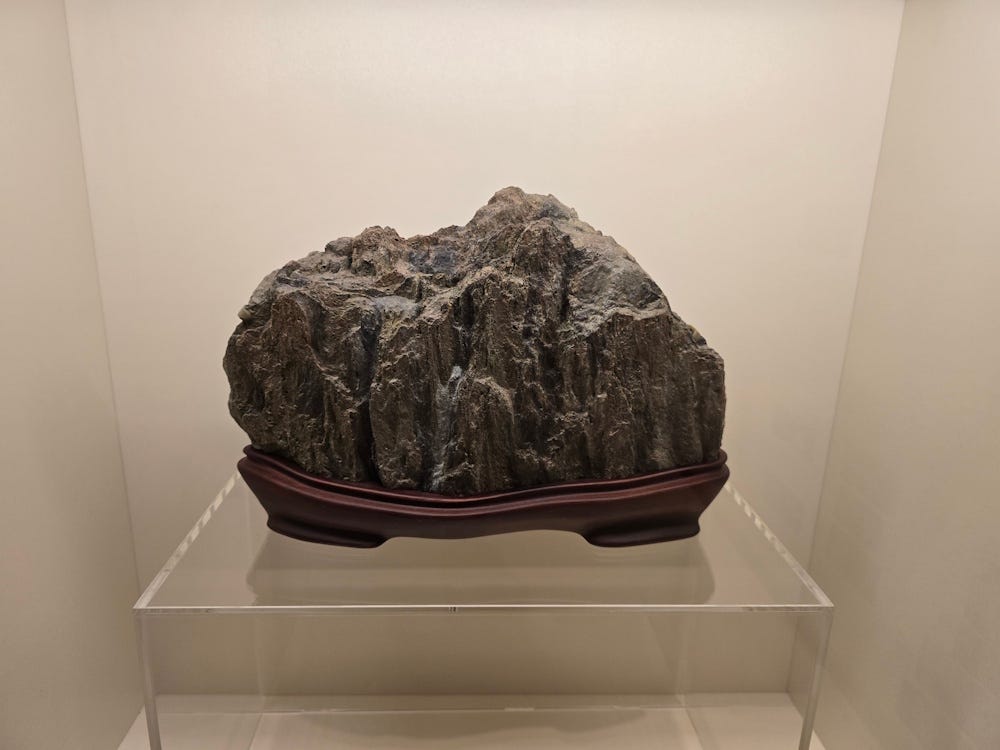
Recently, a pool of industry professionals and critics hand-picked by the New York Times voted Parasite (2019) the best movie of the 21st century so far, and this has caused some confusion among those who saw it and didn’t find it all that great. To be sure, it is an enjoyable film. If I had to give it a numerical rating, it would be a 6.5 or even 7 out of 10. It is certainly not bad. But although we might only be a quarter of the way into the 21st century, there was absolutely no reason to consider it the best. So, how did this happen?
Well, the first reason is incredibly simple: America is going through a strange phase in which its critics and educated population are grossly overrating everything to come out of South Korea. For instance, quite a few people have noticed that virtually no K-pop albums are ever critically panned, even while western pop stars can occasionally still get mixed or even bad reviews. Although this fact can partially be blamed on the critical trend of “poptimism,” which has resulted in less overall negative reviews for pop singles or albums in general, the difference is still noticeable. The same is often true of Korean movies as well. I first noticed it after watching The Yellow Sea (2010), a borderline incoherent, overly long, ultraviolent mess of an action movie with a plotline that seems to forget the story it was originally trying to tell. Put plainly, it was a piece of garbage. And yet, it was an overwhelming critical success, even though some of the critics didn’t even seem to know why they were praising it. One review from The Guardian mostly characterizes it with negative language — “…evident implausibilities…” “…does not really hang together…” “…could perhaps have lost 30 minutes…” — and yet still inexplicably gives it four stars. I believe that this review showed a bit more honesty than most do regarding your typical piece of Korean entertainment.
But the second reason for Parasite’s critical success is a bit more complicated and, I think, more interesting. It has to do with the manner in which the film vaguely suggests a political message yet never quite delivers one, giving the critic plenty of leeway to fill in the gaps for himself. The Korean audiences, for their part, overwhelmingly enjoyed the film, and to them it depicts Korean social inequalities pretty well — and that’s about it. It has an accurate subtext, but it also contains some exaggerations used for symbolic or expressive purposes. For most westerners who watch the movie, however, its exaggerations are hard to parse with any clarity. One doesn’t know if a given scene is a realistic depiction of Korean society, a symbolic artistic gesture, or both, and so the viewer must choose. I’ll give a quick example. The film implies that the rich people all live in elevated areas with plenty of sunshine, while the poor people live down low in the darkness, closer to sea level, so that when the rain comes down and it starts to flood, the poor homes deal with all the flooding, the grime, and even the shit (literally) from sewage spills and plumbing malfunctions. The visual symbolism couldn’t be more on-the-nose. But is that correct? Well, Korea did have an issue with one low-income neighborhood that dealt with flooding due to the abandonment of some nearby dykes, so there’s an actual historic referent to what’s happening in the film. But it’s the visual presentation of this obscure issue that should tantalize the politically interested outsider with no immediate knowledge of its reference points. Are all the poor apartments at lower sea level? Are the poor literally low, while the rich are literally elevated? Maybe yes; maybe it’s just symbolic. But if you don’t know, the symbolic and the mimetic can fully merge into one interface.
The same idea holds particularly true in respect to the psychology of the film’s characters. In fact, that will be the main focus of this discussion. It is difficult to determine if the characters are behaving in either an exaggerated (perhaps even folklorish or mythopoeic) way, or rather in a psychologically accurate but merely “Korean” (i.e., foreign and strange) way. And I think the inability to tell is what has made the film so compelling for so many international viewers. Although one article accuses western filmgoers of only seeing the movie as foreign as opposed to universal, I’d say that exactly the opposite is true: the film faintly suggests a serious political message, and so western critics, hungry for political catharsis, can resolve all of these confusing or gray areas based on the message they want the film to convey. Its “otherness” paradoxically has made it more universal than it would have been if it were specifically designed for an international audience.
Some critics have taken great pains to explain many of Parasite’s Korea-specific references in order to emphasize what they perceive as its political seriousness. One ambitious attempt I’ve found comes from Jacobin Magazine’s Max Balhorn, and his article does a good (and helpful) job of clarifying some things that I wouldn’t otherwise have gotten. But in order to argue that the film contains a grave message about “neoliberalism” and the way it robs us all of our human dignity, Balhorn has to ignore the actual behavior of the film’s protagonists almost completely. This is something that seems hard to do considering how they act as the film progresses. In the beginning, we see them struggling to get a wi-fi connection with their phones, leeching off of nearby businesses (something I’ve done at least a few times), and we observe them as they deal with insect infestations and other various hardships of poverty. We start to feel bad for them. So far, so good. But once the opportunity to make some serious money arises, we see them behave in ways that exceed mere criminality and veer into outright sociopathy.
One of main characters of the film, the impoverished young-adult son Ki Woo, is visited by his college friend who gives him a suseok, or scholar’s stone, thought to bring good fortune (more on that later). He also offers Ki Woo a tutoring job for a very rich family. The college boy is in love with the girl whom he has been tutoring, and so he trusts his friend not to make a move on her while he completes his studies elsewhere. So he encourages Ki Woo to forge some documents saying that he has graduated from university in order to replace him as her tutor for a little while. But then, once Ki Woo gets the job, he lies about his sister’s credentials to get her a job as a private art therapist for the family’s young son. In itself, such an action is at least morally understandable, but after that point, we break entirely from all possible justification for what the family does. The daughter almost instantly frames the family’s professional driver for sexual perversion by taking off her panties and placing them in the back seat of the rich guy’s car. Once he is fired, they set it up so that he’s replaced with the dad, who of course has forged documents and pretends to be an experienced pro driver. The family then gets the live-in maid fired by exposing her to allergens that could potentially kill her (which the family eventually does by the end of the movie) and lying about how she has tuberculosis. The rich family then replaces her with the poor family’s mom. Oh, and Ki-Woo betrays his friend — the guy who got him the job in the first place — by seducing the girl he wants to marry, even stealing and reading her diary so as to psychologically manipulate her with maximum precision. All this before the first half of the movie is complete.
One blog post by the libertarian professor Alex Tabarrok argues that Parasite was deliberately intended to make the poor family look bad and the rich family look good, and that the received left-wing interpretation about social inequality amounts to a “collective gaslighting.” Much like libertarianism in general, I found the argument glib, simplistic, and unconvincing. It is hard to believe that there was any intention to make the family seem lazy or symbolically indicate that they’re “shitty” just because they deal with sewage problems in their run-down neighborhood. But despite the sloppiness of the interpretation, Tabarrok does one thing right: he actually takes the family seriously as rational and ethical agents — human beings with free will who make their own decisions. In most other interpretations of the film, the only people with agency are from the rich family. Because they’re rich, they’re maximally responsible for every little thing they do and say, and everything they say is a clue that reveals their inmost thoughts and feelings. But because the poor family is poor, everything they do is excusable and even automatic, as though “the invisible hand” of the marketplace is reaching out, clutching them by the neck, and forcing them to be bad.
To be sure, there are some aspects of the story that convincingly bolster a left-wing reading of the film. For instance, early in the movie, the family gets a job folding pizza boxes. Turns out, they suck at it, and so 10% of their pay is docked from an already low-paying gig. It is therefore interesting that they are so bad as pizza-box-folders, but when they are put into the position of usurping some high-paying jobs in a rich family’s household, they show an extraordinary amount of skill and calculation, even genius (one scene shows the son and the father rehearsing a script together that the former has prepared for the latter to say to the rich mom). One of the very few outright negative reviews of Parasite that I found chalks up their incredible change in aptitude to poorly-conceived psychology on the part of the filmmakers. Maybe so, but the more intuitive interpretation is that the family is actually quite smart, a wellspring of untapped potential, and thus they’re bad at repetitive mindless work but will thrive in jobs that require creativity and complex decision-making. Such a reading matches a common complaint that the political left tends to make about the demeaning work that characterizes most of the labor market.
Another such aspect concerns their smell: the young rich boy is able to recognize that everyone in the poor family smells the same, which raises some suspicion since they’re all pretending to be unrelated. Although the family considers using different soaps and detergents to fix the issue, the daughter recognizes that it won’t do any good because the young boy is smelling the scent of the rented half-basement that they all live in, making the problem essentially unsolvable. Later on, the father distinctly says (in his polite way) that the father Ki Taek smells like “the people who ride the subway.” Again, these facts all bolster the interpretation that the film is about how low-income people are stunted by uncontrollable circumstances rather than their own deficiencies.
But again, this quest for a unified political message fully breaks down when the viewer is forced to confront the actual family itself, especially during the second half of the film in which the plotline descents into outright absurdity. And the left-wing treatment of the family, which treats their actions as mere chemical responses to what evil market forces have imposed upon them, just simply isn’t convincing. When it comes time for the Jacobin writer to say something critical about the family, he actually criticizes them for a scene early in the movie in which they say a prayer and give thanks for the rich family who just hired them all. This scene apparently shows that they have been taught to “regard poverty as a consequence of their own moral failings, not the result of a system built on exploitation and perpetual precarity.” Never mind that they do not once make an explicit reference to their own moral failings throughout the entire film. They have nonetheless internalized “the logics [sic] of late capitalism” because they thanked a higher power for the existence of a rich family who wanted to give them some money. Yes — the only scene in which they show a bit of humanity, and this is what the Jacobin guy takes issue with!
If that’s the proper interpretation, then strangely enough, it actually places the viewer further into the “logics” of late capitalism than if one were to render a negative judgment on their warped behavior. The film regularly dares the viewer to associate the poor family with actual parasitic insects, and the symbolic connection grows increasingly stark as the film progresses. It’s as though the viewer’s faith in humanity is being tested — “No!” you’re meant to say, “They aren’t parasites! They are human after all!” But if you go with a purely exculpatory reading of their moral behavior, then you yourself have essentially dehumanized them and are accepting that they are insectoid parasites, even if ones that “neoliberalism” created.
After all, just ask yourself: why are we made to root for this family? It isn’t because of who they are as fully-rounded people with an inner-life, and it certainly isn’t because of their great moral virtue. It’s because they’re poor, and they’re highly competent. Their appeal breaks down to a) their class status, and b) their skills. We like skillful, intelligent people because we can instrumentalize these things. Skills and intelligence lead to productivity. Productivity fuels the market. If they were simply weak and incompetent dullards, then we wouldn’t have much to say in their favor. “Neoliberalism” might rob them of their humanity, but in recognizing this, we’ve gone along with the premise entirely. This is an entirely different situation from what we find in the highly Marxist Italian neorealist cinema, which placed strong demands on the directors to always show the proletariat as essentially moral people who never do anything lawless out of extraneous greed or hedonism (a rule that Pasolini broke in Accattone, 1961).
But at the same time — and this is what makes the movie interesting — the wiliness and craftiness that the family shows are perennial traits seen cross-culturally in the protagonists of many great legends and folk stories. What we now call “fairy tales,” often with morals tacked on at the end of each one, have typically descended from once-amoral stories dealing with taboo subjects such as incest, rape, cannibalism, and murder. Occasionally, traces from this forgotten, unsanitized past can be found in various records of the tales themselves. The recently translated stories collected by Franz Xaver von Schönwerth contain plenty of examples. Another one that we all know is the “Stone Soup” folk tale, about a wanderer who tricks a village into putting stew ingredients into a cauldron of boiling water merely by convincing them that he possesses a magic, edible stone. He then shares the soup with them, everyone realizes that the stone didn’t do anything, and they all learn a great lesson about sharing and the importance of community. How touching. How sentimental. But there’s also a Hungarian version of the same tale in which a traveling soldier tricks an old widow into emptying out her pantry by convincing her that he has a magical soup-making stone, and once they finish eating the soup together, he actually sells her the worthless stone since she still believes that it is magic. There is no moral to be found; it’s just a guy scamming an old woman. And this is probably closer to the original oral version of the story (other attestations from different countries depict a single old woman getting tricked in much the same fashion), which makes the trickery the story’s real purpose. All of that “community sharing” stuff that you were taught as a kid was a later addition.
Parasite uneasily straddles the line between that same kind of simplified, exaggerated, folkloric mode of storytelling (in which a lack of moral purpose is fully acceptable) and the newer mode of socially conscious storytelling that leftism has historically demanded — one that calls for mimetic realism, incisive commentary on social conditions, and evidence of the protagonists’ moral decency. And I think the clearest indicator of this tension is found in the scholar’s stone, the suseok that Ki Woo is given in the beginning of the movie. Suseok stones are manuports. They’re interesting or unique stones found in nature used to decorate various places such as gardens, burial mounds, or the desks of scholars. They date back to ancient times not only in Korean culture but East Asia more generally, and they’ve symbolized many things throughout the ages. A suseok stone might signify a sacred peak or axis mundi (center of the world) — a perennial, cross-cultural concept. It also might reflect the Daoist concept of wu wei, or non-action: the embracing of what’s natural and unaltered. In the Joseon dynasty, suseok stones represented endurance and humility, traits to which every Confucian scholar should aspire. And, as this article makes clear, in the 1980s after about a century of obscurity, they re-emerged in public consciousness, becoming popular (and expensive) marketplace collectables for the Korean nouveau-riche — trinkets that they felt would make them seem sophisticated and worldly.
If we consider these diverse and even contradictory associations, the suseok stone in Parasite becomes all the more emblematic of the film itself. And the stone plays no small role in the movie, too. It continues to resurface throughout the development of the story as the family descends further and further into desperation and depravity, all the way until Ki Woo’s head is literally smashed with it at the film’s climax, “hoist with his own petard.” But what makes the stone so appropriate is that it suggests contradictory sensibilities in much the same way as the film does. Even the way that it’s presented feels completely out-of-place. When Ki Woo receives it, his friend tells him that it’s thought to bring good fortune, and later on, when their basement-apartment is flooded, we see the stone magically floating up to the surface, presenting itself to Ki Woo as an ideal murder weapon. One could get away with interpreting the stone as a cursed object that puts the whole story into motion through sheer fairy-tale magic. And yet, the object itself is all too worldly and contemporary. On the one hand, it points to an ancient epistemology, one that corresponds with the exaggerated, grotesque, and parable-like structure of the film’s storyline. But on the other hand, it is also a symbol of modernity and commerce, and although the poor characters become psychologically less and less understandable as the storyline progresses, we also find them embodying the debased commercial principles that the stone can imply more than the ancient ones. The family certainly doesn’t reflect the principles of Daoism, nor do they show endurance or humility. At one point, the father Ki Taek hypocritically claims that the only reason the rich family is nice is because they can “afford” to be nice, as though decency is itself a commercial commodity. Did “neoliberalism” force him to say this?
Rock appreciation is an interesting thing. Rocks have no agency, no free will, and no ability to tell you their thoughts. But if you understand nature, you can sometimes determine some things about the environment that the rock comes from just by observing it. You can tell if it’s volcanic or comes from a beach. If it’s a sedimentary rock, you can get a sense of some of the depositional conditions that formed it, like the water depth, oxygen levels, or biological activity. You aren’t entirely clueless. And yet, nevertheless, you can only determine so much: if you want to visualize its originary environment, you have to use your imagination. You have to guess. The family from Parasite functions much the same way. We can guess that they’re merely byproducts of “neoliberalism” or “late capitalism,” but they themselves don’t actually tell us much about what these things are or what they do to the psyche, nor could they. Like suseok stones, they are highly unique and unusual. But also, like suseok stones, we as westerners don’t really know enough about the culture surrounding them to make an educated guess as to what their characteristics really suggest. They lie in between both worlds, and their foreignness can let us merge these worlds into one with ease. Call it “the suseok principle.”
Even the climax of the film attests to how inconvenient the psychology of the family members can be for the person who wants to draw a universal political lesson from their story. The film’s grand cathartic moment in which Ki Taek stabs the rich father to death is not presented as inevitable but rather as erratic; a spur-of-the-moment lapse in judgment. It isn’t an instance of the proletarian’s triumph over the rich but rather as the triumph of randomness over predictability; spontaneity over convention. It certainly says something… but what, exactly? One cannot know. Just as Ki Woo says with such banality to his friend upon receiving the stone, “This is so metaphorical.”
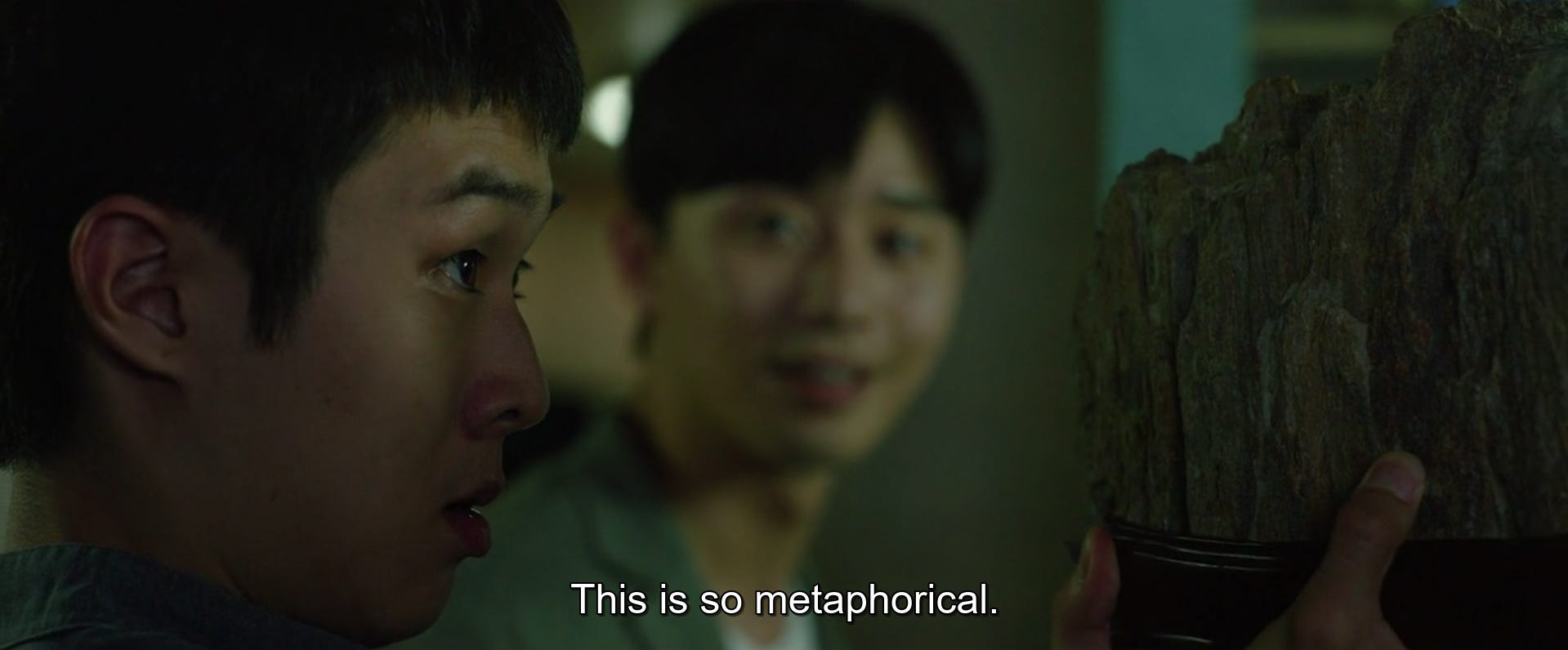
Because of this narrative instability that I’ve tried to explain — i.e., the film’s unclear space between the universal and the local, the ancient and the modern, the archetypal and the mimetic — I find its denouement largely unsatisfying. After telling a good, enjoyable, and amusing mess of a story, the movie jerks back to a heavy-handed point about the hopeless poverty of the father’s son and wife, as if to reassure the viewer, “This is what the story was really about.” But once it gets to that point, its implausibility has reached its highest peak. How did Ki Woo miraculously recover his mental faculties after receiving such extreme levels of brain damage? How is the father conveying entire letters to his son in morse code using the light switch from the mansion’s bomb shelter? Why would he think that his son would be there? And why would the son even think to transcribe them? How would he even know when a letter is beginning and ending? And if the father is able to leave the bomb shelter to steal food from their refrigerator, then why not just leave the house and visit his son for a day or two before returning? We’ve “jumped the shark” at this point, even while the tone has become maximally sentimental. But if you’re a western viewer, you can interpret all of these absurdities selectively. You can take them back to the level of the archetypal or purely symbolic — the foreignness of the story encourages it all the more — and still remain focused on what’s ostensibly the “serious” message about income inequality under “neoliberalism,” which is of course highly realistic and contemporary. And that’s the suseok principle at play, here.
I’m no connoisseur of Korean entertainment, but I wouldn’t be surprised if this principle has occurred elsewhere when western audiences have expressed similarly unrestrained positivity regarding films (or series) from nonwestern cultures — just as long as those films vaguely gesture towards a serious political statement.
Just got out of lockup / jail tried to message you I can't get into any old accounts message me back on Twitter or here I missed you I don't really have an online presence or want one but I do want to message you or say hi
Hey I lost everything again and it will be a minute before I have solid accounts I can't log In I just wanted to reach you