
The Digital Bandar-Log
On "Kaa's Hunting" by Rudyard Kipling

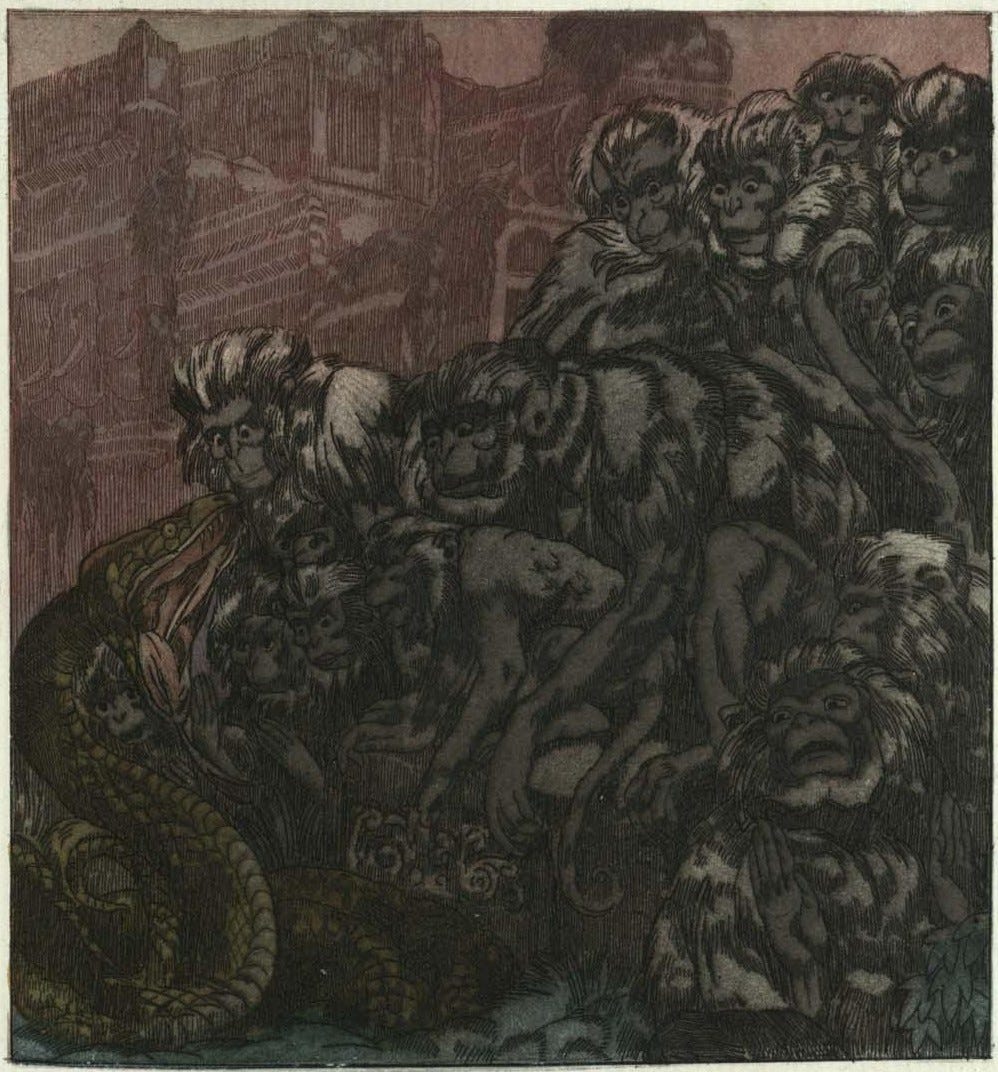
What Baloo had said about the monkeys was perfectly true. They belonged to the tree-tops, and as beasts very seldom look up, there was no occasion for the monkeys and the Jungle-People to cross each other’s path. But whenever they found a sick wolf, or a wounded tiger, or bear, the monkeys would torment him, and would throw sticks and nuts at any beast for fun and in the hope of being noticed. Then they would howl and shriek senseless songs, and invite the Jungle-People to climb up their trees and fight them, or would start furious battles over nothing among themselves, and leave the dead monkeys where the Jungle-People could see them. They were always just going to have a leader, and laws and customs of their own, but they never did, because their memories would not hold over from day to day, and so they compromised things by making up a saying: “What the Bandar-log think now the jungle will think later,” and that comforted them a great deal.
We still haven’t figured out the implications of the internet. We don’t know what governments will wind up doing about it, and how the law will affect its reach. And we have no idea what will happen once “the global village” or “the global theater” (whatever you prefer) becomes truly global. Like Theseus, we’re feeling our way around the lair of the minotaur, trying fecklessly to gain some understanding of its layout, yet only with time will the full picture come into relief.
Take, for instance, the question of who’s using the internet. During the 1990s and into the ‘00s, the internet was a white man thing. It was filled with quirky white man humor. But the rest of the world has started catching up, and whites only make up roughly 10% of the global population, while blacks make up 14% and rising. As of 2021, a little over 40% of all Africans have access to the internet, a rapid rise from 2012, in which it was just 9%. Asians (an admittedly heterogeneous category) make up 60% of the global population, however. That’s a big number. As for India alone, about 67% of its population has access to the internet, making up 971,000,000 people, with a rapid rise similar to Africa’s from the previous decade. India now makes up the second-largest internet market, with China at #1, and it has plenty of room to grow.
This means that we’re only now getting a sense of what the internet really is like when the whole world is connected to it. And not everyone likes what they’re seeing. For instance, some backlash against the Indians has started to brew. They’re being regularly accused of gaming social media monetization schemes using engagement farming tactics, and these accusations probably have some merit. We’re also seeing the rise of increasingly bizarre and lazily-made AI content becoming wildly popular, with both the creators and viewers likely originating from either India or somewhere in the third world. These trends will assuredly continue for a good while.
I can’t defend the Indians from such criticisms, but I can at least partially redeem India by sharing a story that takes place in one of its vast jungles, since I think it serves well to illustrate a key dynamic of the digital world. And sure, it may not have been written by an actual Indian — only an Englishman who lived in colonial India as a teenager — but never mind all that. I’m talking about “Kaa’s Hunting” (1893) from Rudyard Kipling’s The Jungle Book, and I’d like to focus specifically on the Bandar-log, a group of wild monkeys who live on the periphery of ordered life within the jungle.
The story begins as Baloo (a bear) and Bagheera (a black panther) are teaching Mowgli, an abandoned small child whom they’ve decided to rear as their own, about the laws of the jungle. Because it’s the jungle, no one is literate, and thus the laws cannot be written down, so Baloo and Bagheera have a useful mnemonic strategy for the oral transmission of law: physical abuse. If Mowgli fails to remember a law, he is struck by Bagheera until he remembers. Baloo and Bagheera disagree about the extent to which corporal punishment should be applied, but they are united in their certainty that the laws must be taught one way or another. Their system is thoroughgoing and rigorous, faintly recalling the methods in which Vedic teachers would pass down the Vedic verses to students for thousands of years before they had been written down. And in order for the jungle to function properly, the laws must be remembered and observed. In The Jungle Book, Kipling get surprisingly philosophical. He identifies a close connection between nature (φύσις) and the law (νόμος), with the latter building quite comfortably upon the former, complementing rather than opposing it.
But Mowgli, smarting from all of Bagheera’s punishments, is more interested in the Bandar-log, a group of monkeys who live on the outskirts of society, since they give him little trinkets and tell him that if he joins them, they’ll make him their leader. Mowgli likes all of this, even though Baloo has specifically forbade him from socializing with them. The Bandar-log are anarchic and exist in a parasitic relationship with the rest of the jungle. They would have laws of their own, but the problem is that they lack any kind of mnemotechnics, as the latter part of the quote flourish above explains. So instead, they only live as outcasts. Of them, Baloo tells Mowgli,
They have no speech of their own, but use the stolen words which they overhear when they listen, and peep, and wait up above in the branches. Their way is not our way. They are without leaders. They have no remembrance. They boast and chatter and pretend that they are a great people about to do great affairs in the jungle, but the falling of a nut turns their minds to laughter and all is forgotten. We of the jungle have no dealings with them. We do not drink where the monkeys drink; we do not go where the monkeys go; we do not hunt where they hunt; we do not die where they die.
So in addition to having no laws or mnemotechnics, they also have a poorly-formed language which they thoughtlessly recite, imitating the speech patterns of others yet lacking any kind of refined system to maintain precision and consistency in their words.
The Bandar-log also live above the other animals in the treetops, swinging about from vine to vine. They have no rooted connection to the earth and can only look upon its ways with confusion. Although they would welcome order and hierarchy into their lives, they have no ability to hold onto such things, and thus they are forever confused about the relationship between nature and the law, perennially on the verge of creating a lasting system but always falling short. What they really want, the text makes clear, is for everyone else in the jungle to pay attention to them and essentially worship them.
In this story, they kidnap Mowgli and take him to a place called “The Cold Lairs,” a city once inhabited by humans but subsequently abandoned, which the monkeys enjoy sometimes frolicking around in before they’re back up in the trees. The following passage explains it:
The monkeys called the place their city, and pretended to despise the Jungle-People because they lived in the forest. And yet they never knew what the buildings were made for nor how to use them. They would sit in circles on the hall of the king’s council chamber, and scratch for fleas and pretend to be men; or they would run in and out of the roofless houses and collect pieces of plaster and old bricks in a corner, and forget where they had hidden them, and fight and cry in scuffling crowds, and then break off to play up and down the terraces of the king’s garden, where they would shake the rose trees and the oranges in sport to see the fruit and flowers fall. They explored all the passages and dark tunnels in the palace and the hundreds of little dark rooms, but they never remembered what they had seen and what they had not; and so drifted about in ones and twos or crowds telling each other that they were doing as men did. They drank at the tanks and made the water all muddy, and then they fought over it, and then they would all rush together in mobs and shout: “There is no one in the jungle so wise and good and clever and strong and gentle as the Bandar-log.” Then all would begin again till they grew tired of the city and went back to the tree-tops, hoping the Jungle-People would notice them.
The reason that they kidnap Mowgli and bring him there is that he has the ability to do something they can’t: he can weave sticks together and build little huts for protection against the harsh winds. In other words, he has the gift of artisanship (or τέχνη), though the way Kipling explains it is curious. No one has ever taught Mowgli how to build any of these structures; it is an instinct that he has only inherited because his father was a woodcutter. Here, we can see hints of Kipling’s Lamarckian evolutionary thinking poke through the text, though it may not be entirely off-base: we still don’t quite know if inborn yet seemingly technical behavior, like the way a spider constructs a web, is inherited strictly through natural selection or additionally influenced by epigenetic transmission. Whatever the case may be, the point is that Mowgli has inherited the knowledge of a craft that was technically refined and perfected over generations, giving him a kind of blood memory even as the craft itself was originally conceived through advanced technique — something that the Bandar-log will always fail to have. And so, admiring Mowgli’s impressive “play,” they decide that if they kidnap him, they will make him their leader, become truly impressive themselves, and then everyone in the jungle will notice them and agree that they’re the best.
Baloo and Bagheera, however, know better. Once they discover that Mowgli has been taken, they approach a python named Kaa, a dangerous and mysterious night hunter whom they’d rather not have to deal with. They explain the situation to him, and Kaa instantly recognizes the problem: because the Bandar-log always forget what they’re doing, they’ll eventually grow tired of Mowgli and discard him like everything else they play with. Thus, he is in grave danger.
And these suspicions are proven correct when Mowgli is brought to the Cold Lairs and the Bandar-log become annoyed with his desire to leave them:
Sore, sleepy, and hungry as he was, Mowgli could not help laughing when the Bandar-log began, twenty at a time, to tell him how great and wise and strong and gentle they were, and how foolish he was to wish to leave them. “We are great. We are free. We are wonderful. We are the most wonderful people in all the jungle! We all say so, and so it must be true,” they shouted. “Now as you are a new listener and can carry our words back to the Jungle-People so that they may notice us in future, we will tell you all about our most excellent selves.” Mowgli made no objection, and the monkeys gathered by hundreds and hundreds on the terrace to listen to their own speakers singing the praises of the Bandar-log, and whenever a speaker stopped for want of breath they would all shout together: “This is true; we all say so.” Mowgli nodded and blinked, and said “Yes” when they asked him a question, and his head spun with the noise. “Tabaqui the Jackal must have bitten all these people,” he said to himself, “and now they have madness. Certainly this is dewanee, the madness. Do they never go to sleep?”
Eventually, the Bandar-log throw Mowgli into a room filled with snakes, whom Mowgli calms down using the words of the jungle that have been taught to him, and then Kaa shows up to fight with the monkeys. After Kaa saves the day and rescues Mowgli, he hypnotizes all of the monkeys, who are powerless to resist the sway of the chthonic. But Baloo and Bagheera are accidentally hypnotized as well, and Mowgli, the only one unaffected by Kaa’s powers of entrancement, pulls his mentors out of their mesmeric state. Once Baloo and Bagheera are back to normal, they all go home. Mowgli, in the end, is punished for consorting with the Bandar-log and giving them the idea to kidnap him. That’s how it ends.
Every time I re-read this story, it grows increasingly difficult for me not to associate the Bandar-log with online communities, who function in a similarly lawless, leaderless, and perpetually forgetful state of existence. In a post called “Thedes and Hordes,” I marked the difference between what I call thedes, whose bloodlines are settled within a distinct telluric environment (even as hunter-gatherers or nomadic tribes), and what I call hordes, who lack a territory altogether and whose bonds are forged entirely through abstract communication. Online social groups are hordes, while thedes are groups with a distinct physical presence and location. Given the genre of children’s beast fables that Kipling is using, the Bandar-log come about as close as one can get to a horde as I’ve described it. They sometimes hang out in the abandoned city of the Cold Lairs, but they don’t have any real territory, since its architecture means little to them. Instead, they hover above the other jungle creatures, traversing vast spatial expanses at great speed without having a true central location.
Because they’re always up in the air, the Bandar-log operate within a more abstract plane of existence, never having the need to abide by ordinary laws even though they are aware that they could benefit from some. Just as I’ve said that hordes are always fascinated by the telluric plane of existence and seek to assess each other according to its standards, the Bandar-log show similar fascination towards both the abandoned Cold Lairs (wherein they play-act as government council members) and the jungle creatures, whose attention they strongly crave. Although they see themselves as superior, the Bandar-log (hordes) ultimately want to be worshipped by the jungle creatures (thedes) and prove that they are winners according to their standards.
The need for the Bandar-log to “play politics” is quite striking, since that is what they seem to enjoy about visiting the city ruins. They never develop an understanding of statecraft any more advanced than a cargo cult trying to understand how airplanes work, but politically mobilizing themselves seems to be the ultimate goal they have in mind, which they prioritize over the things that would help them achieve it, like developing a mnemotechnics, a consistent language, or a body of laws. Impressed by his gifts at techne, they immediately recognize that Mowgli would make a good leader, but without any deeper substance to guide their decision-making process, they cannot remain persistent in their loyalty, rendering his technical instincts worthless.
In the same way that they put the cart before the horse regarding their political aims, their views on language are similarly confused. As the lengthy quotations indicate, they decide that “what the Bandar-log think now, the jungle will think later,” ignorant of the fact that they will not be able to recall what they think at the present moment later on. And, when talking to Mowgli about their greatness, they tell him, “We all say so, and so it must be true,” as if the declaration stands ontologically prior to the fact. On the one hand, this understanding of language is quite primitive, even animistic, but it converges with how people are prone to understanding language from the most abstract possible vantage point as well. See: the most superstitious expressions of “social constructivist” theory canonized by various speech-policing left-wing tumblr blogs during the late ‘00s, popular occultist self-help books like The Secret, or the “Meme Magic” of the 2016-era alt-right.
The most important aspect of the Bandar-log, however, is their inability to remember anything, something Kipling repeatedly stresses throughout the tale as the foremost reason for their backwardness. I’ve covered the want of collective mnemotechnics among online communities before, like over in this lengthy post, and although it might at first not be clear as to why an internet community would be so bad at remembering things, it starts to make sense if you think about the nature of online socialization for a moment. Just about every expert on mnemonics knows that memory is best achieved through corporeal and spatial associations. It isn’t something that our brains achieve unless we find a way to assign meaning to it, and what we find most meaningful is earthly in essence, not abstract. But the internet is an abstract realm, and the communities that come from it are thus borne of abstraction. Therefore, they must seek out non-abstract ways to form a body of lasting memories that might give their group some sense of cohesion. As I remark in that post,
The digital landscape is an abstract one in which ideas of all forms endlessly present themselves to an individual and then fizzle out as fast as they had arrived — not necessarily because they are no longer available, but rather because the individual has become distracted by something else and has moved on. The internet is loaded with nearly all the information from our known universe, but its widespread availability is not conducive to any kind of collective memory. Memory must be limited by the contours of time and distinct experience, and thus it will always stand opposed to the universalism that the “world wide web” entails. Even digital tribes with universal aims and prescriptions, ones that refuse to recognize themselves as tribes, inevitably run into this problem. Without reference points to shared experiences in the physical world, the digital landscape will never be sufficient for the long-term preservation of any digital tribe.
It is striking that even though the Bandar-log don’t apparently face the problem of dissolution as digital tribes/hordes do, they still would need memory to create laws and technical achievements as a means of attaining recognition for themselves, and yet they themselves cannot recognize this problem, since in order to be aware of your inability to remember things, you must be motivated by necessity. The Bandar-log move with great agility that humans would require advanced technology to emulate, but their great mobility and independence from the jungle terrain is also what ultimately weakens them mentally.
Not wanting to belabor this comparison too much, I’ll wrap it up here and leave it to the reader to consider other unstated parallels between the mentalities and social practices of the maximally primitive Bandar-log and the maximally sophisticated internet hordes. But I’ll end by saying that the influx of third-world internet users will probably make these parallels stronger, or at least make them more apparent. On Elon Musk’s “X”, for instance, I regularly find content-farming accounts making the same exact posts over and over for engagement, and it’s striking how few people seem to remember that the posts have been made before, even when it’s clear that many of these people engaging with the posts spend more time on the site than I do. Some of them even give the same response over and over again to the same posts, totally unaware that the same exact thing was said verbatim just a few months prior. As the late John Miles Foley observed more than once: in both the technological framework of primary orality as well as on the internet, “repetition” feels more like “recurrence.”
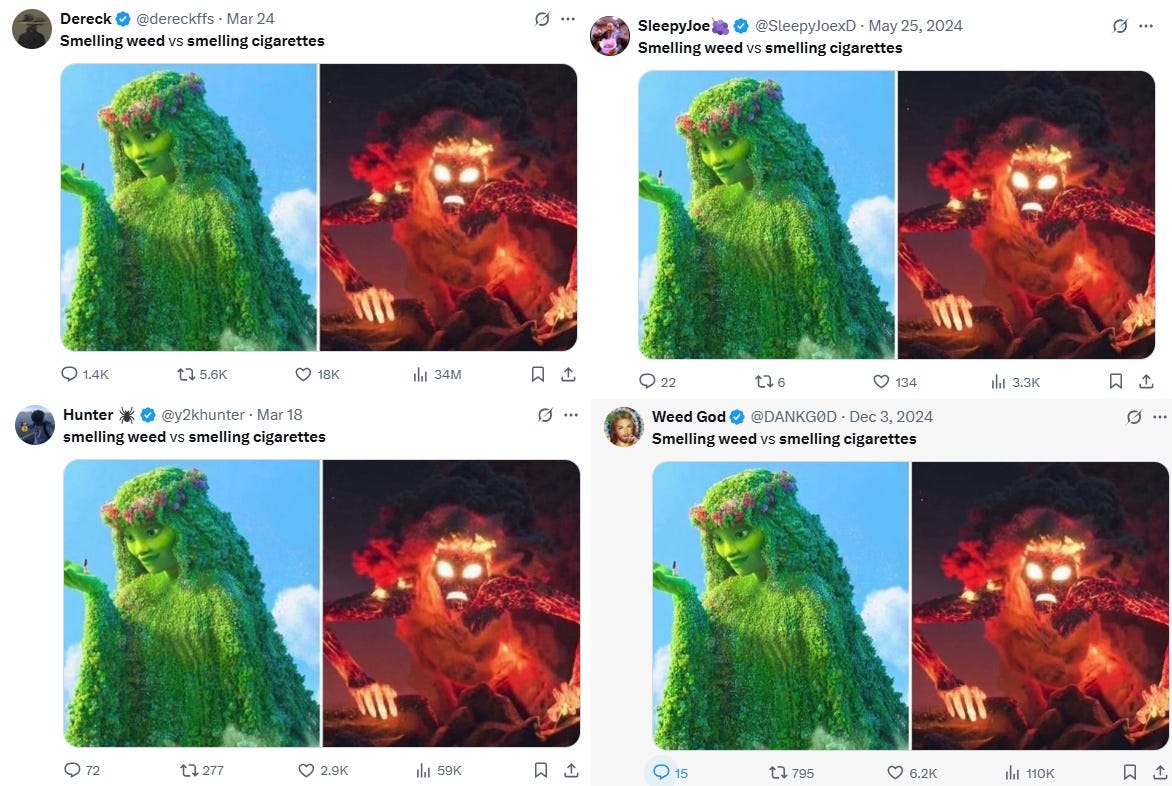
And though this has been going on years, the problem has gotten so blatant that people are finally starting to notice — I am far from the only person who has observed the memory-erasing effects of the digital world on man. But how the situation will shake out remains to be seen. For now, just remember that the Bandar-log can be abbreviated to “B-log.” And micro-blogs are the most influential mode of online communication currently in use.