
Art Forms of Mere Selection
If you want to be an artist and you're too lazy to make things, simply isolate what's already there

You’re reading Steam Calliope Scherzos, a blog that traffics in media, semiotics, and cultural analysis.
“Art,” as everyone knows, stems from the Latin ars, artis, which originally denoted a skill or handicraft — something that you work on and master over years of practice. It also did not necessarily mean something that you create just for aesthetic value: farmers were adept in the “art” of agriculture, while blacksmiths were adept in the “art” of metallurgy, and the much-debated distinction between “artist” and “artisan” simply did not exist for the majority of human civilization. The primary origin of both words is actually found in the proto-Indo-European root “ar-,” which meant “to fit/put together.” And from that same root, we now have the modern English words “arm,” “army,” “harmony,” “article,” and “aristocracy.” So, if you were putting stuff together in the spatial realm, you were engaging in a kind of art, even though you may not have been consciously aware of it.
But times change, and words can change their meanings with it. Only in the 18th century, the time of the enlightenment, did the understanding of “art” begin to correspond to a strictly aesthetic realm of experience — one encompassing such sensations as “the beautiful” or “the sublime,” or any range of emotions or affects — divorced from the framework of everyday utility. No longer could the artist and the artisan be the same: a blacksmith and a farmer weren’t artists, because art was to be admired or studied rather than used. This new understanding was not shared by everyone, of course, nor is it now. Utility has remained a consideration regarding the arts and their appreciation up to the present day: it is very common to hear people describe a film as a “date movie,” or describe a certain song as “dance music,” or describe a novel as “therapeutic.” But the average person knows that this attitude towards art isn’t considered very fancy, or hoity-toity, or highbrow.
Attempts to deviate from this mentality have largely resulted in failure. The composer Paul Hindemith helped popularize the term Gebrauchsmusik, or “utility music,” during Germany’s Weimar era, but by the 1950s it had almost universally become a term of derision. Essentially, the lowbrow view is that you should use art for specific purposes, while the highbrow view remains quite enlightenment-based: art has to be fundamentally useless other than for its aesthetic effect.1 During the twentieth century, the advent of modernism pushed this notion from the enlightenment much further than it was ever intended to go. Then, following World War II, the liberal intellectual class reintroduced sociopolitical considerations through the backdoor, but in a non-consequentialist way: art must be socially responsible (however the term is defined), but not to engender a particular outcome. A good piece of art can’t simply be propaganda (a bad word): its effects must be indirect, slowly changing the collective consciousness to become morally and socially good.
With considerations on art prohibited from addressing all but its sociopolitical outcomes and its aesthetic effect (and the aesthetic experience itself remains a highly contentious matter), it should come as no surprise that the longstanding expectation of craftsmanship and technical skill would have fallen by the wayside as well, ultimately severing the connection between “art” in the modern sense and “art” in the traditional sense entirely. For that reason, something can now be art simply by dint of it a) existing, and b) being called “art” by someone, somewhere. And with this modern definition in mind, we can look back into the recesses of history and discuss the first works of art, realizing that they predate the Lascaux cave paintings by not just thousands but millions of years. We can also discuss some of the most recent works of art whose status as “art” is still hotly contested, and we can place them in something of a lower-case T tradition. So today, I will discuss five types of art in which the artistry involves nothing more than selection. Not creation, not production, not invention, not technique, not even inspiration… but simply selection.
The Manuport
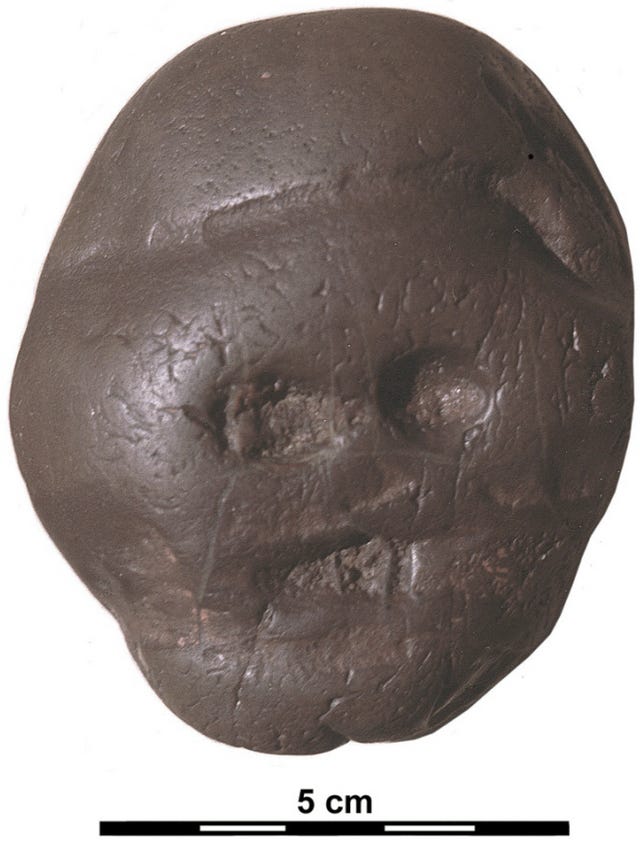
The manuport is a pretty simply concept. It’s an object that has been picked up, hasn’t been modified, and has been moved somewhere. Any time a toddler picks up a pretty rock and brings it home with her, she’s collecting a manuport. Now, the earliest known manuport collected by a human (or at least a hominin) was the Makapansgat pebble, pictured above. It dates to about 2-3 million years ago, during the age of Australopithecene man, which is considered the earliest stage of humanity. It was first discovered in the 1920s in a cave residing within the Makapan Valley north of Makopane, South Africa, and within that same cave had been discovered some apparent Australopithecus bones (although it may have been another contemporary hominid species). Although the pebble was only discovered by a local schoolteacher, we have little reason to suspect that it was a fraud, because the significance of the item wasn’t even contemplated until decades after its discovery. Anthropologists have since determined that the tiny little pebble must have been picked up and moved since it was discovered in a cave, away from its natural environment. And although there’s still some debate about the matter, the most likely reason that it was in foreign territory is that some little Australopithecus ape-man found it interesting and felt like taking it with him. It does, after all, look like a little guy. Just look at him.
There’s a semiotic significance to this that the linguist and anthropologist Dan Everett has written about in his book How Language Began (2017): if the pebble was collected and moved because it indeed does look like a little guy — and no one has come up with a better explanation so far — then it means that man, before creating language, prized objects for their iconic significance. In other words, man has always cared about things that directly resemble other things and has found that resemblance interesting for its own sake.
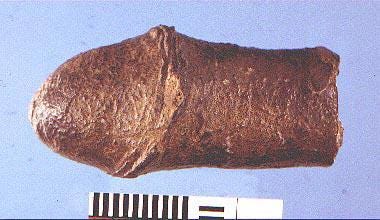
Another example of an early manuport is the Erfoud cuttlefish, a cuttlefish fossil that looks like an unsheathed non-erect penis, and is even roughly the same size as one. Anthropologists estimate that it dates from 200,000 to 300,000 years ago. And again, it is unmodified.
As with other art forms, manuports have gotten more complex and extravagant with time. In the far east, there’s a longstanding tradition of stone appreciation, known as suseok in Korea, suiseki in Japan, and gongshi in China. In all three traditions, naturally occurring yet visually interesting stones are picked up and used to decorate an area, like a scholar’s desk — although sometimes these stones are modified, so not all of them are pure manuports.
Whether modified or not, these stones are typically extravagant and impressive, and they often do iconically represent other objects, landscapes, or collections of things. This example of an unmodified Japanese suiseki stone below seems to suggest a ship, or perhaps a lamp:
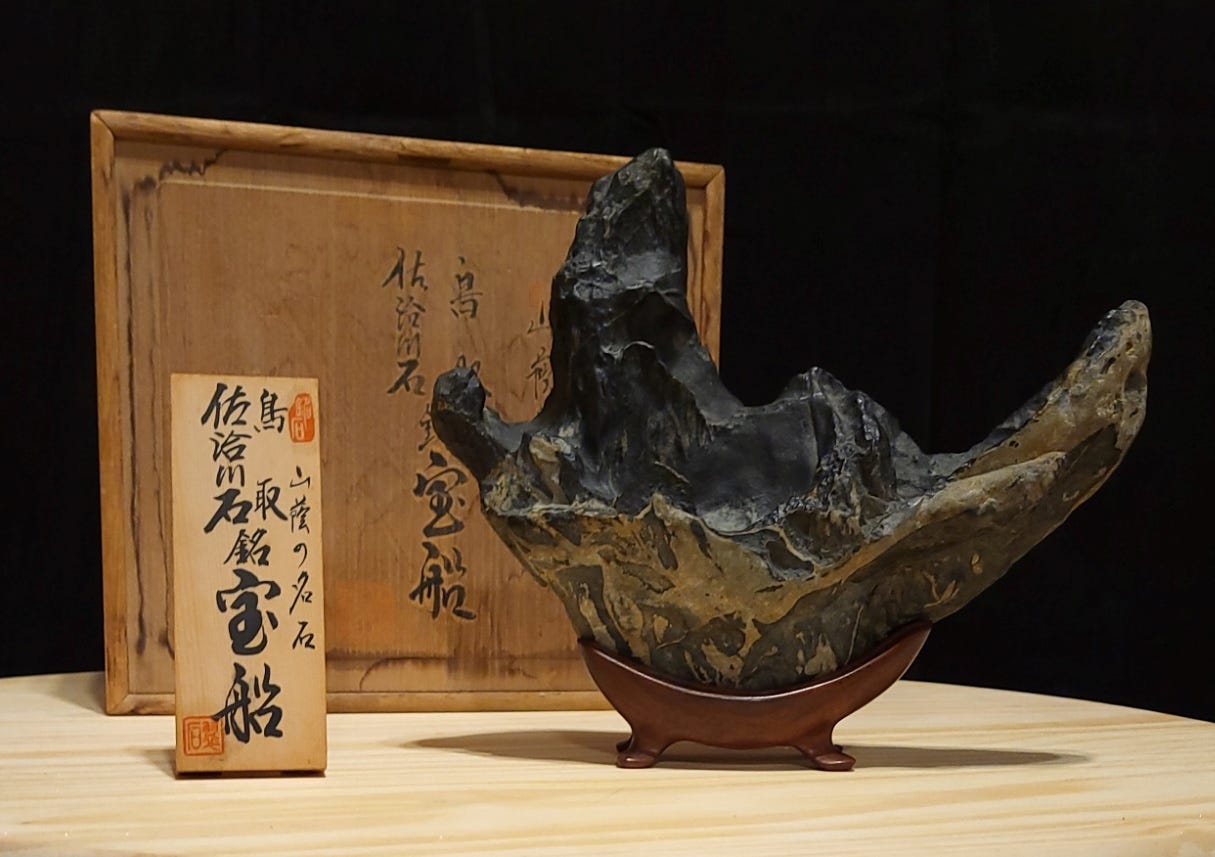
Whatever it is, you can mentally connect it to something, in much the same way that staring at clouds is fun because they, too, can resemble other things. But of course, iconic representation isn’t necessary: as long as it’s something one can ponder over for a while. The cultural significance of these stones has also varied over time. As I explain in my article Suseok Cinema,
A suseok stone might signify a sacred peak or axis mundi (center of the world) — a perennial, cross-cultural concept. It also might reflect the Daoist concept of wu wei, or non-action: the embracing of what’s natural and unaltered. In the Joseon dynasty, suseok stones represented endurance and humility, traits to which every Confucian scholar should aspire. And, as this article makes clear, in the 1980s after about a century of obscurity, they re-emerged in public consciousness, becoming popular (and expensive) marketplace collectables for the Korean nouveau-riche — trinkets that they felt would make them seem sophisticated and worldly.
Perhaps they became increasingly artificial rather than unmodified when more nouveau-riche started to purchase them. I’m not really sure. But the unmodified manuport forms the primary selection-based art form, and thus it is the template for all the others that follow. For a long while during the history of civilization, purely selection-based art forms didn’t exist. But eventually, in the modern world, once the meaning of “art” became re-evaluated, more art forms came along that brought selection to a level of profundity it previously did not have.
The Daguerreotype/Photograph
When the daguerreotype was first introduced in the 1840s, everyone loved it. The reception was quite warm, and frankly it should have been. What a mind-blowing invention! But intellectuals started to wonder if taking pictures in such a manner could be considered an art. After all, you’re not doing as much as a painter. This question persisted with the arrival of the proper “photograph” (on paper instead of copper plates), and then the hand-held camera, then the digital camera, and truthfully, it still persists among anyone who feels like taking up the question. Alongside this impossible philosophical debate, there was another one about how the photograph should be situated alongside drawing and painting. Should the other art pictorial forms change now that the photography has come along — a kind of “mirror” of the world around us? The history of the fine arts gives us an answer, which is a resounding “yes,” as less literal and outwardly mimetic art forms began to proliferate, from cubism to surrealism to futurism to dada.
Of course, when people have thought about the art of photography, they’ve typically been thinking about everything the photographer does all the way up to and following the snapshot, not so much the snapshot itself. And with digital photography now being the norm, there is not much to do after the picture has been taken, the complex process of developing a roll of film no longer being a consideration. So, it’s now just the “before” part that people are interested in. If you’re a celebrity photographer, for instance, the art is in setting up lighting, finding a location for your subject, perhaps putting together a scene of some kind, picking out or commissioning some costumes or props, and then doing a proper photoshoot while telling your subject how to pose and what to do.
But let’s say you don’t feel like bothering with all of that, and you just want to walk around with your camera — the one affixed to your computerized phone, which everyone in the first world owns nowadays. The art, in that case, is simply about being in the right place at the right time and having the wherewithal to point it at something and press the button. The photo is now the work of art. As such, it stands as an act of interjection wherein the photographer disrupts the continuum of reality and isolates a single instant within it, selecting that image from within that instant for some audience’s attention and consideration. It’s art, in other words, because you decided to choose it.
Now, the photograph, in Peircean semiotic terms, is not just an icon (again, something that resembles something else directly) but also an index: it’s something that points (however vaguely) to something real that existed in concrete space and time. Paintings have only an attenuated indexical function that can vary widely. Let’s say, for instance, that you decide to paint a portrait of someone. It’s possible that your skill is so great that a perfect stranger will be able to see your painting and recognize that it’s depicting a real person in a specific location, like for instance a distinct street corner… so that is in some sense an index. But it’s possible that you sketched the background beforehand, painted the person there, and then finished the background later, meaning that the person was never in that location. It’s even possible that you’ve painted the whole thing from imagination. Photography can be highly illusionistic, of course, and photography hoaxes have been around for as long as the camera itself (see the 19th century spirit photography trend). But for the most part, a photo tells the viewer that something took place somewhere in a distinct place and time, even if it’s unclear where or when it happened.
The Field Recording
The field recording is more or less the same thing as the photograph but in sonic form. It originates from a 1940s art-music movement known as “Musique concrète,” which involved the creation of sound recordings depicting everyday and mundane things, which were then manipulated to create a specific sonic effect. Over time, though — starting around the late 1960s, to be exact — recording technology got better, and people just started making field recordings with little alteration.
The process nowadays is pretty simple: you go get your digital audio recorder, you go somewhere in which the sounds are interesting, or soothing, or whatever, and you record it. You’ve become an artist by your mere act of selection, only instead of intruding upon the flow of time and isolating a single still image from somewhere in physical space, now you’re selecting a specific series of vibrations that occurred somewhere within an expanse of time. To put it crudely, whereas the camera captures space, the audio recorder captures time. And as with the photograph, it is both iconic and indexical: if I can hear some birds chirping somewhere and then it starts to rain, then I know some birds were chirping somewhere before some rain fell at some point in time.
The idea of the field recording is that you’re capturing “ambience,” though this isn’t as straightforward a concept as one might first assume. Ambience suggests that some noise is taking place in the background, but the whole point of listening to a field recording is that it’s now at the foreground, being the object of contemplation. The subtle noises of nature work most ideally to invoke the notion of “background-ness,” and perhaps even certain products of human technology, like cars or a lawn mower. But let’s say you’re recording the forest for six hours, and you keep encountering hikers walking by your device who, for whatever reason, are each blasting trap rap songs from a portable speaker — an apparently growing phenomenon. Are you making a good field recording? Does your field recording act as a powerful commentary on something-or-other? You certainly can’t copyright it, because the music technically isn’t “yours,” nor is it considered part of the public commons despite its apparent inescapability, even in the safe haven of the green world. Oh, well.
There is one other important consideration to make for both the field recording and the photograph, and it’s that both can be used for utilitarian purposes. A photograph can be used as a piece of evidence for a criminal trial. A field recording, like this one, can be used as a sleep aide. Obviously, however, once you’re using it for something productive, it has ceased to be a work of art. Having made that qualification, let’s move on.
The Ready-made
The ready-made was pioneered by Marcel Duchamp in 1917 when he took a urinal, turned it onto its side, signed it as “R. Mutt,” titled it “Fountain,” and put it into a gallery for exhibition. The audacity of such a choice on Duchamp’s part created a shock, and so he made some more ready-mades, and thus the artistic genre was born. This act of reappropriation bore some resemblance to the photograph insofar as it involved extracting something from an environment, isolating it, and forcing it to become an object of contemplation. However, the intention was not to produce a strictly visual phenomenon here, since Duchamp was deliberately commenting upon the concept of art itself through this gesture. He was aware that he was producing the kind of thing that would compel one to write an essay. His “ready-mades” weren’t intended to be either beautiful or ugly but simply mundane, and that was meant to be the source of their profundity. As he explained to the art historian Pierre Cabanne,2
In general one had to defend oneself against the ‘look.’ It is very difficult to choose an object because after a couple of weeks you come to like it or detest it. You have to achieve something so indifferent to you that you have no aesthetic emotion. The choice of ready-mades is always based on visual indifference as well as on the complete absence of good or bad taste.
In this sense the ready-made is the conceptual opposite of the manuport. The manuport is selected for its uniqueness — the fact that it stands out amid the mundane, enough to compel someone to take it and keep it in a collection of some kind. Here, the ready-made, by virtue of its blandness, diverts one’s attention away from the object and onto to the house that stores it. It’s an attempt to call into question the contextual situation in which it can occur at all.
Or, at least, that’s what it was when it first began. In the decades that followed, ready-mades became increasingly devoid of such conceptual content simply because they had been accepted as a genre of modern art. Once accepted, the original meaning had to vanish, and a new meaning had to surface. A good example of the ready-made’s conceptual transformation is Tracy Emin’s “My Bed” from 1998, which is just the artist’s actual bed next to a rug covered in off-putting things like underwear stained with menstrual blood and used condoms. The point is no longer to question the process by which something becomes “art,” as with Duchamp, but instead to focus on Tracy Emin and the boldness with which she reveals her sordid lifestyle to the rest of the world:
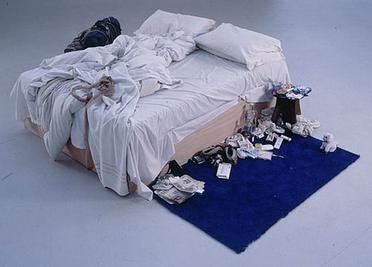
Again, the phenomenon isn’t altogether visual. It’s part of the “confessional” mode, a kind of “chick lit” fixture found in autobiographical or semi-autobiographical novels, and certainly stand-up comedy. Lots and lots of stand-up comedy. According to the artist Jonathan Bowden, Emin was one of the much-discussed “Brit Pack” artists to come out of Goldsmith College in the 1990s, along with Gavin Turk and Damien Hirst. They were later seen as examples of the “Cool Britannia” cultural phenomenon during that time, a media creation that Tony Blair was able to capitalize on during his early years as prime minister, and which was largely forgotten after the Labour Party’s associations with George W. Bush and the Iraq War of 2003.
Much of the reason for the ready-made’s staying power is, in fact, sociopolitical. Although Duchamp played the joke over a century ago, conservatives and right-wingers never fail to take the bait and express outrage over the same shopworn gesture, regardless of how familiar it has become. Some of the cleverer ones feign boredom rather than act enraged, but this fools nobody. Thus, while Duchamp was engaging in a kind of internal criticism, today’s ready-made acts as a pretext for the art world to engage in outward criticism against the rest of society, playing the role of the embattled survivor who has undergone such torrid abuse and vicious misunderstanding.
A.I.-generation
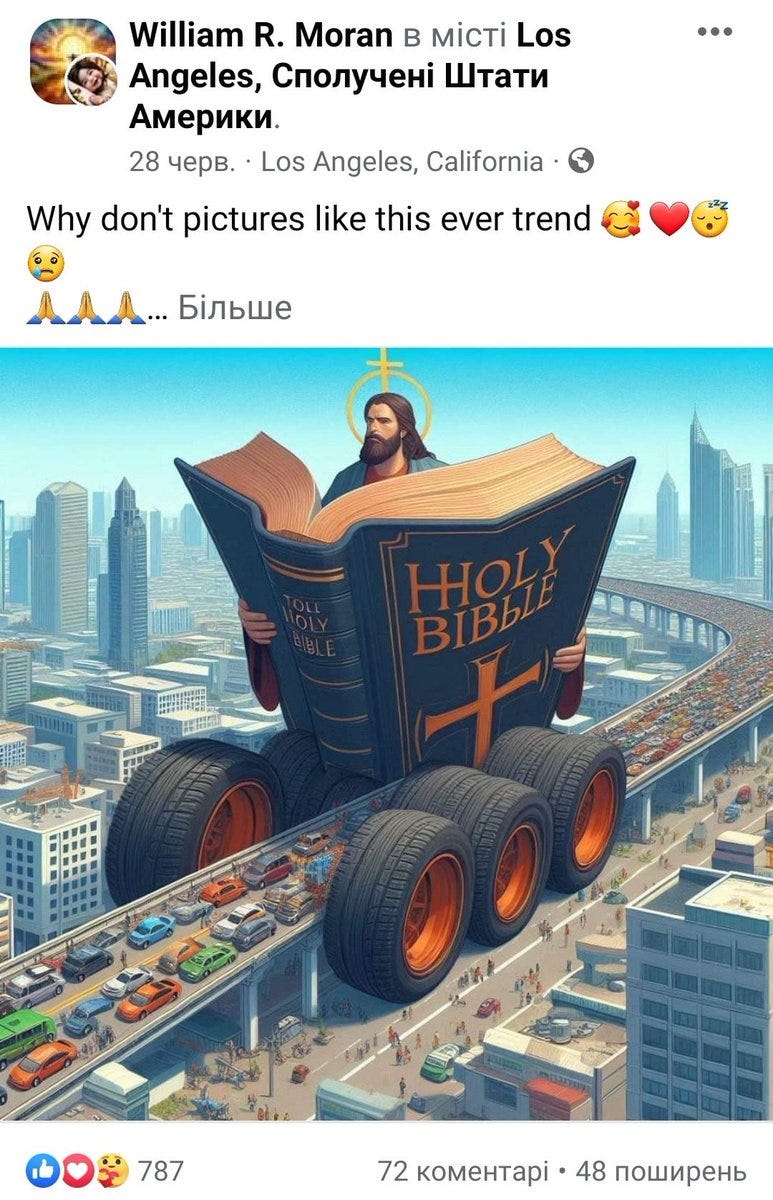
The last style of art-by-selection that we will discuss is AI art — at least the kind that involves a minimal amount of pruning, editing, and finessing. Slowly, society seems to be differentiating between AI art that should be considered “slop” and AI art that isn’t slop. For instance, the animator Emily Youcis’s “Will Stancil Show” isn’t slop, since it is scripted and heavily edited together. But the kind I’d like to discuss briefly is the slop, which now has its own Wikipedia page.
With AI-generated art, the user comes up with a prompt and enters it into a computer, which generates an image (or video, or song, or whatever) that loosely approximates what the user requested. The computer is trained to generate novel content based on material that has been previously collected. Going through a vast storehouse of information, the computer regurgitates a combination of previous works from various media and various sources, treating the user’s prompt as a guideline for what to retrieve. During the enlightenment and romantic periods, intense philosophical debates arose about what imagination means, and the romantics decided that imagination is not merely the ability to mentally combine things together, as many had previously assumed. Rather than being a “mirror,” the imagination is more like a lamp, which can illuminate things not previously understood.3 Given that definition, we would have to conclude that AI is wholly unimaginative. It is more like the mirror than the lamp, and what it provides for the user is more like a collage than a work produced from scratch. And the collage, for what it’s worth, is an object of fascination among the postmodernists, since it amounts to an array of disparate signifiers, all pointing to various heterogeneous contexts, laying bare their alterity, their différance, even as the artist aims to push them all toward a distinct statement of his own. Or something like that.
Anyhow, the reason AI-generated art is an art of selection is because of the process through which it becomes curated and presented to the world. Before the user gets the result he wants, he will have to generate many versions of his prompt and select just one or two. The experience of AI art-generation is like using a slot machine. You pull the lever, and come up with nothing. Then you pull again — and again, you get nothing. You keep pulling it over and over until finally you get something that resembles what you had in mind, and so you choose it to put it on display. In this sense, there’s nothing ironic or heady about the process, as with the ready-made. AI-generated art is much more like the manuport, the most primitive art form there is. In the same way that little children will walk around a field looking specifically for a four-leafed clover, the AI-user will look for something specific and rely on the computer’s vault of information — its mirror of the natural world — to finally realize it.
Here, the artist is still the AI-user rather than the AI itself, since all of the effort goes into isolating and selecting a result. The situation recalls the dream of the long-defunct and discredited Situationists, who included Guy Debord, author of Society of the Spectacle (1967). Those guys essentially wanted to overcome the power of “the spectacle” — a parasitic kind of consumer art that replaces lived experience — by dissolving the boundaries between art and everyday life altogether. Essentially, in the Situationist utopia, everyone would be an artist, and the mystique of the profession would go away while everyone lived out their art in real-time. Today, we seem to be on the precipice of that mystique finally disappearing, even as “the artist” still suggests a kind of ethos or differentiated relationship to the rest of society — a hangover from the romantic period, without a doubt. But in reality, with no expectation of technique and artisanship affixed to the notion of art, everyone is now an artist in his spare time. And boy, oh, boy. Isn’t it great?
It is quite possible that the highbrow doesn’t actually exist anymore in contemporary life. That is, no one might actually be highbrow in their tastes. But all the same, the imagined highbrow still exists, and that’s all that matters here.
Quoted in Martin Jay’s Downcast Eyes: The Denigration of Vision in Twentieth Century French Thought (1993)
This debate is exhaustively discussed in M.H. Abrams’s The Mirror and the Lamp: Romantic Theory and the Critical Tradition (1958)